How to Lower Turnitin AI Score Before Submitting (Safely)

Wondering how to lower your Turnitin AI score before submitting? Yes — by rewriting your own prose so a statistical model is less likely to misread it, not by running it through a humanizer. The moves that work: read every sentence aloud and fix the ones you'd never say, break uniform sentence rhythm, and keep the specific details only you could write. Then run the real engine, edit against the actual highlights, and recheck — revising against a guessed number is wasted work. This page does not cover washing AI-generated text.
A note on authorship. Full disclosure up front: the team at InDetect writes this — a third-party pre-submission checker that runs your paper through the real Turnitin engine using authorized instructor accounts. We have a commercial interest in you caring about your AI score, so we're not a neutral observer. The editing techniques below cost nothing and come from ordinary writing practice.
Key Takeaways
You can lower a real Turnitin AI score by editing your own writing, not by outsourcing it to a humanizer.
The flag comes from statistical patterns — even rhythm, templated structure, word clusters — not any single "AI word."
There's no official passing percentage. Below 20%, Turnitin shows *% instead of a number, and schools set their own thresholds.
False positives cluster in specific writing: citation-heavy passages, lit reviews, prose flattened by heavy editing tools.
The only workflow that works is check → edit → recheck against real reports.
1. Can You Lower Your Turnitin AI Score? Yes — Here's the Honest Frame
Let's be clear: this isn't a guide to beating Turnitin. If a paragraph came out of a model and you want to keep it, there's no honest advice here, and no service we know of — including ours — will launder it for you.
What does work: adjusting your genuine writing so the detector is less likely to mislabel it. The AI panel estimates how statistically predictable your text is. Humans write lumpy — uneven rhythm, personal quirks, odd specifics. Models write smooth and generic. The more your prose sounds like one particular person (you) wrote it in a particular week, the less of a statistical target it presents.
So "lowering your score" here means shrinking your false-positive surface, not gaming a number. The test: if your professor read your drafts side by side, the edited version should still be recognizably yours.
2. What Actually Triggers the AI Writing Flag
Turnitin describes its AI detection as measuring statistical patterns like low perplexity — predictable word choices. We use only what Turnitin publishes publicly and claim no internal parameters. But you can feel the concept in your own draft.
Three patterns attract highlights:
Uniform sentence rhythm. Five sentences in a row of 20–28 words reads machine-smooth. Real writing alternates: one long clause that wanders and picks up a parenthetical, then something short.
Templated structure. Every paragraph opening with a topic sentence in the same shape. Parallel triads ("clear, concise, and compelling"). Models love these because training data loves these.
Predictable word clusters. "Delve into," "underscores," "in the realm of," "pivotal," "multifaceted." One use isn't a flag. A cluster in one paragraph is a strong hint.
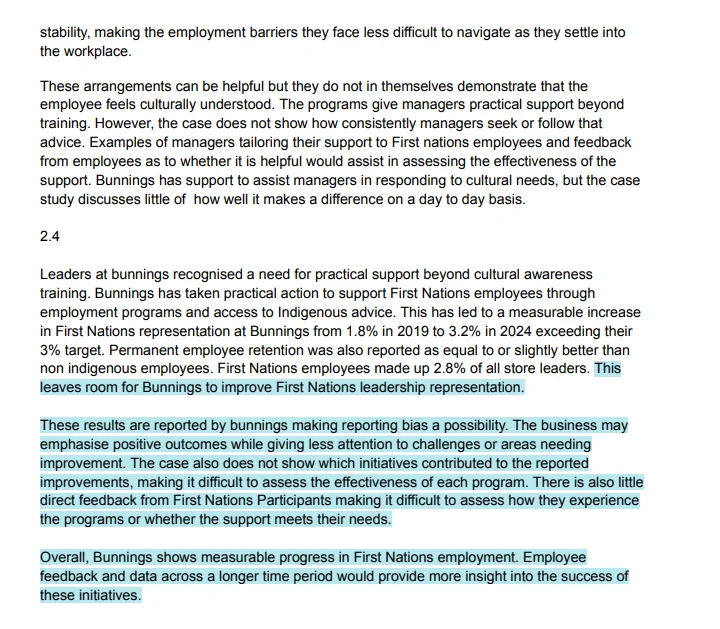
A flagged sentence from our test paper was grammatically flawless, 31 words long, and could have opened an essay on any topic. Rewritten to say something only our seminar would say, it lost the highlight on recheck.
3. What Is a Good Turnitin AI Percentage for a Paper?
No official passing line exists. Turnitin publishes no threshold; some instructors glance at anything above 20%, others act only when a high score comes with other red flags.
One mechanic matters: between 1 and 19%, the report shows % instead of a number. Turnitin hides low-confidence figures because the false-positive rate there is too high to display as fact. Our explainer on what the % score means breaks down the whole asterisk behavior.
Turnitin also discloses an error margin of about ±15 percentage points, so a reading of 30% could sit anywhere from the high teens to the mid-40s.
The bare number rarely gets a student pulled into a meeting — the number plus an inability to explain the work does. Walk in with version history, dated notes, and a draft-to-final story and a 40% is survivable. Without them, even a 25% gets ugly.
4. "My Score Is 76% but I Wrote It Myself" — Start Here
High scores on human-written text are common, and they aren't random. Triage your report like a mechanic.
First, where do the highlights cluster? If they sit on quotation-heavy passages, your lit review, or a dense methods section, you're in false-positive territory — formal, citation-saturated prose looks statistically model-adjacent. Our breakdown of Turnitin AI detection in US schools covers the Stanford research on false positives, which hit ESL students disproportionately. If that fits you, the number says more about the detector's limits than about your conduct.
Second, check your editing trail. Deep Grammarly rewrites and thesaurus polishing flatten your rhythm into exactly the statistical smoothness the detector hunts — over-editing human text is a quietly common cause of a flagged paper.
Third, read the panels correctly: document-level percentage, sentence highlights, and gray "not analyzed" text are three different things. If any are fuzzy, work through our guide on how to check a Turnitin AI report first.
5. Five Rewrite Moves That Lower the Score
These are editing moves, not evasion moves. Apply them to your own draft.
5.1 Read every sentence aloud. Any sentence you'd never say to a friend gets rewritten in your spoken voice. Contractions allowed. Fragments allowed if you'd actually use them.
5.2 Break the rhythm. Count your sentence lengths. If most land between 18 and 26 words, you're uniform. Split three into short ones, merge two others, let one run long with an aside.
5.3 Put the specifics back. The page number from the book you actually read. The example from Tuesday's lecture. The weird outlier in your dataset. Models write generalities. Generality is what gets highlighted.
5.4 Delete the AI-flavored clusters. Search your draft for "delve," "underscore," "realm," "landscape," "pivotal," "multifaceted." Each is a fine word. In threes, a tell. Swap in the plain word you'd have used before you learned to sound academic.
5.5 Smash the template. If every body paragraph runs claim–reason–evidence in identical shape, break one. Lead with the evidence. Open a paragraph by rejecting a question. Uneven structure is human furniture.
6. The Check → Edit → Recheck Loop
This part decides whether any of the above works: you need the real report, twice.
Simulators and paste-box tools run their own models, not Turnitin's, so their highlights point at the wrong sentences. You need the engine your professor will actually run.
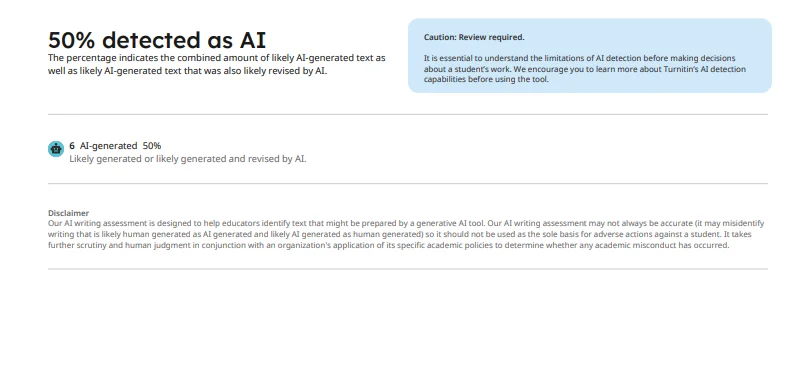
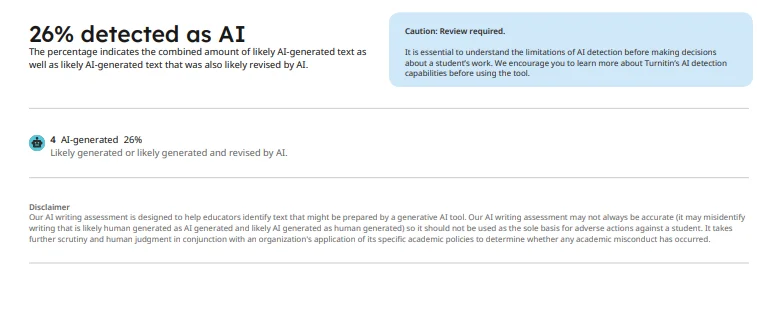
Our own test paper shows the loop working. First draft through the real engine: 50% AI writing, highlights concentrated in the introduction and one methods paragraph. We applied the five moves — mostly rhythm-breaking and specifics. Recheck: 26%.
That's one case, one paper — not a promised drop; nobody who guarantees a specific number is telling the truth. But the direction came from editing exactly the flagged sentences, which only a real report shows. That's the only reason this page recommends a tool: InDetect routes uploads through authorized instructor accounts with zero repository storage, returns the real report in 5–30 minutes, and deletes paper and report within 24 hours. A loop needs two checks, which is why students here usually pick Pro — $19/month for 6 checks ($3.17 each) — over Lite's two.
7. What Humanizers Do (and Why This Guide Doesn't Recommend Them)
A humanizer runs your text through another model and rewrites it until detectors score it lower. Three problems.
Academic: passing humanizer output off as your own is a fabrication issue at most universities — trading an AI flag for an integrity hearing. Quality: humanizers mangle precise language; technical terms, citations, and your actual argument come out smoothed or wrong. Effectiveness: against the real Turnitin engine results are unstable. A tool that lowers a GPTZero score has no reason to lower a Turnitin score.
Every method here keeps you as the author. If your honest draft flags high, edit and recheck. If you can't tell why, take it to your professor or writing center. And if the worry is the other number on the report, similarity needs a different fix — see checking your Turnitin similarity score before submitting.
8. FAQ: Lowering Your Turnitin AI Score — Common Questions
How do I lower my Turnitin AI score before submitting? Edit your own prose: read sentences aloud and fix the unnatural ones, vary sentence length, add specifics only you would know, and cut AI-flavored word clusters. Then get a real report, fix the highlighted passages, and recheck. No method guarantees a specific number.
My Turnitin AI score is too high but I wrote it myself — what does that mean? Probably a false positive concentrated in formal, citation-heavy, or heavily tool-edited passages. Check where the highlights cluster, keep your version history and dated notes as evidence, and read the false-positive research we summarize in our US-schools explainer.
What is a good Turnitin AI percentage for a paper? There's no official one. Below 20% Turnitin hides the figure as *%, schools set their own expectations, and the disclosed ±15 percentage-point error margin means any single reading is approximate.
Does Turnitin AI detection 76% mean I'm accused? No. The AI panel is one input an instructor may choose to investigate — it's not a verdict. Respond with evidence of process: drafts, notes, a tool-use log. Don't respond with panic or a humanizer.
Will a humanizer lower my Turnitin AI score? Unreliably, and at the cost of your authorship. Humanizers target other detectors' numbers, damage precise writing, and their output can itself trigger an integrity finding. We don't sell one and we don't recommend one.
9. Run the Loop, Not the Number
Don't optimize for a score you can't see. Get one real report before the deadline, edit against its actual highlights, and recheck.
New users in eligible countries get one free check (availability depends on your country). Everyone else starts at Lite — $9/month for 2 checks, $4.50 per paper — and every check includes both the similarity and AI reports.