Turnitin AI Detection in US Schools: Adoption Rates, University Policies, Accuracy Results, and the Growing Campus Divide

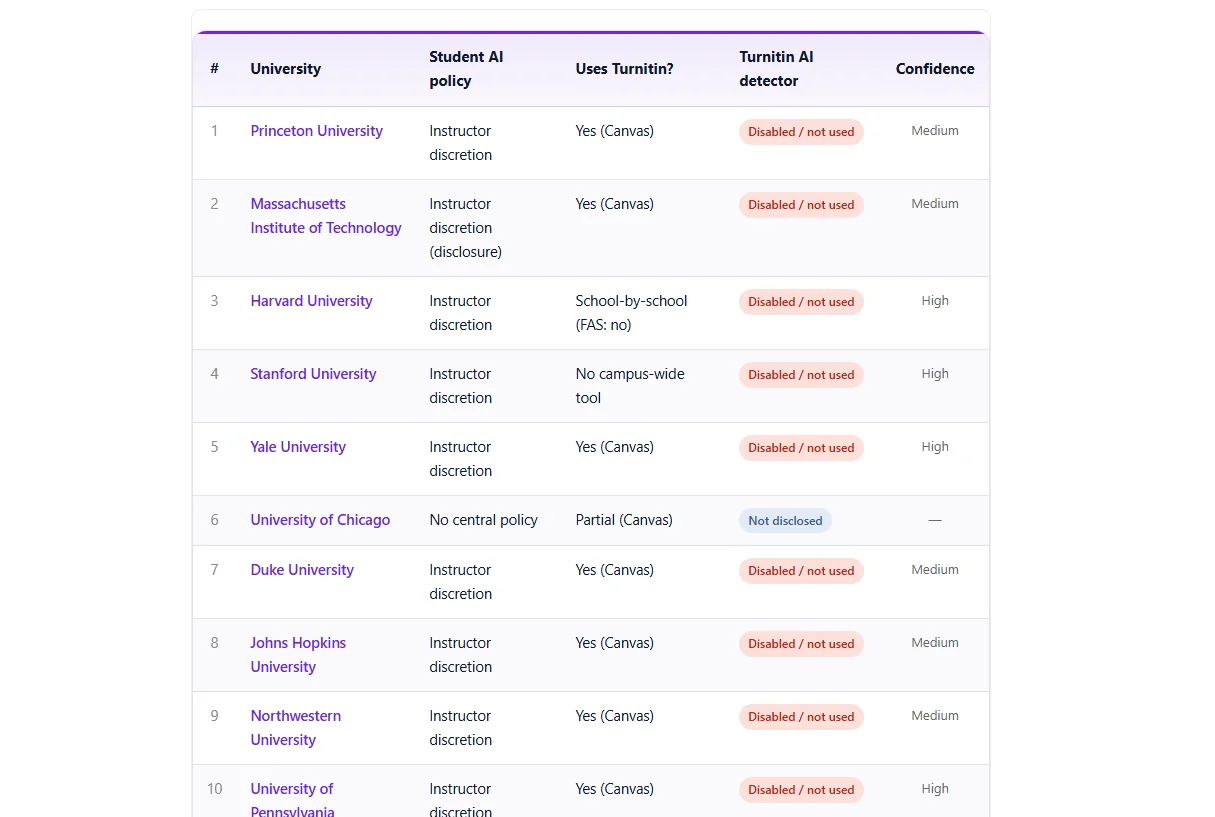
Executive Summary: Turnitin AI detection presents a deeply divided picture in American higher education. While 16,000+ institutions globally (including 4,000+ in the US) have activated the feature, only 2 of the Top 50 US National Universities clearly keep it on — 35 have disabled or declined it, and 13 do not disclose their setting. False positives, documented bias against ESL writers (61% misclassification rate per Stanford), and a growing wave of neurodivergent student misflags are pushing more schools to walk away every semester.
1. Adoption Landscape: Who Actually Uses Turnitin AI Detection in US Schools
1.1 Scale and Scope
Turnitin announced in January 2026 that 16,000+ educational institutions worldwide now use its AI writing detection feature. On paper, US adoption is broad — but dig into elite schools, and the pattern reverses.
Institution Type | Adoption Status | Source |
|---|---|---|
Research Universities (R1/R2) | Near-universal adoption | Turnitin 2026 report (146 R1 + 133 R2 overwhelmingly active) |
Liberal Arts Colleges | High adoption rate | Williams, Amherst, Swarthmore, Pomona, and most Top-50 LACs activated |
Community Colleges | Rapidly growing | California Community Colleges (116 campuses, 1.8M students) activated system-wide in 2025 |
Online / For-Profit | Most aggressive adopters | No in-class authorship verification possible → AI detection is the primary integrity tool |
Top 50 US National Universities | Only 2 explicitly ON, 35 OFF / unused | Detection Drama official policy-page audit, June 2026 |
Timeline of rollout:
April 2023: Turnitin switches AI detection ON BY DEFAULT for ~10,700 institutions; schools must opt out.
Fall 2025: Over 80% of US four-year universities have activated the Turnitin AI module. Community colleges follow in Spring 2026.
2025 single year: California State University (CSU) system spent $1.1M+ on Turnitin, including $163,000 extra for the AI detection add-on.
1.2 Real Student AI Usage Data (Turnitin's Own 33-Million-Submission Dataset)
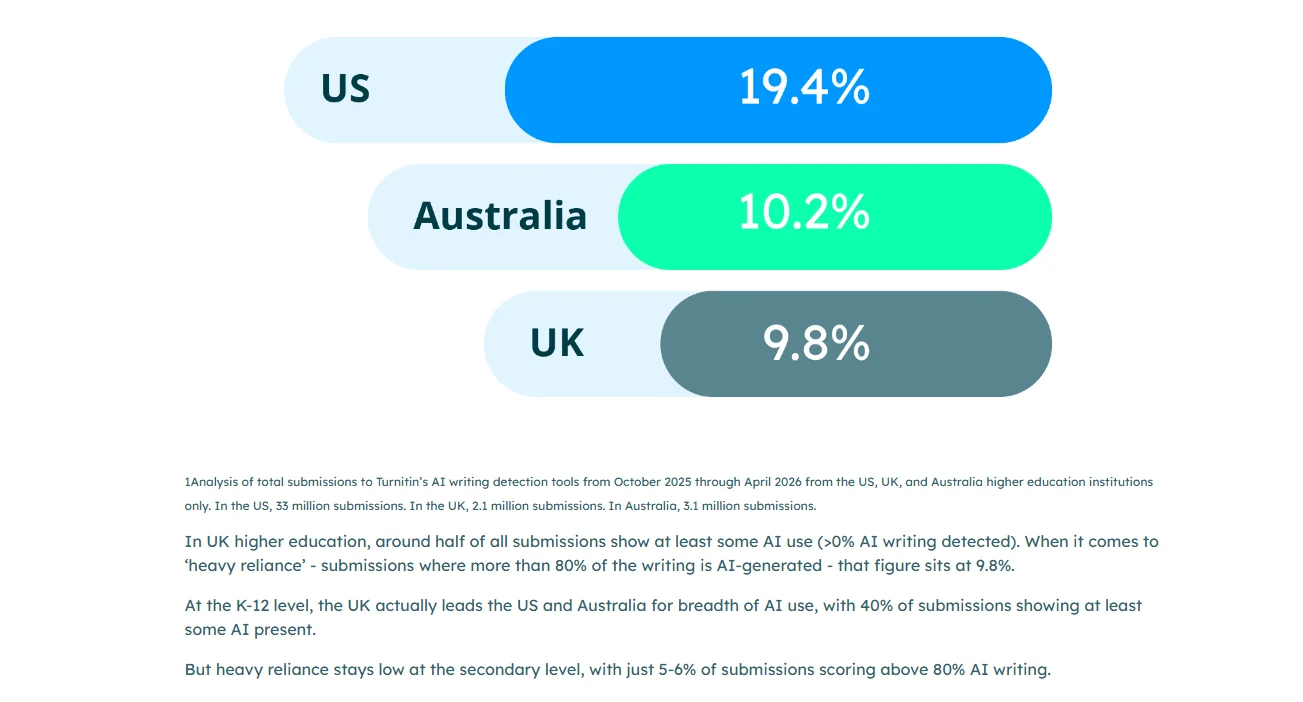
Turnitin's July 2026 Learning Integrity Insights Report — based on 33 million US higher-ed submissions between October 2025 and April 2026 — paints the clearest picture yet of actual classroom AI use:
19.4% of US university submissions show an AI writing score above 80% (essentially full AI authorship)
That is roughly double the rate in the UK (9.8%) and Australia (10.2%) for the same period
At the K-12 level, US students show only 5–6% with >80% AI scores — dramatically lower than higher ed
Growth trajectory: at launch in 2023, only 3.3% of submissions scored >80% AI; by early 2026 that figure had climbed to nearly 15%, and it now sits at 19.4%
1.3 What Happens After You Submit — Score Thresholds
Turnitin runs two independent analyses on every paper: the classic plagiarism similarity check and the separate AI writing detection model. Professors see both percentages side-by-side in the report.
Score Range | What Typically Happens |
|---|---|
0–10% AI | Safe. No action taken at any surveyed school. |
11–20% AI | Gray zone. Some schools investigate at 15%, others at 20%. Professor discretion. |
21–40% AI | Most schools investigate. Student likely asked to explain or resubmit. Drafts and revision history can clear the case. |
41–60% AI | Formal investigation at nearly all institutions. Burden of proof shifts to student. |
61–100% AI | Presumed AI-generated. Treated as serious academic integrity violation: course failure up to suspension/expulsion depending on offense history. |
Two critical fine-print details every student should know:
Turnitin hides the exact number in the 1–19% range, showing only an asterisk *%. This is an admission that the system cannot reliably distinguish AI from formal human writing at low confidence levels.
Turnitin itself documents a ±15 percentage-point margin of error. A 50% score could legitimately be anywhere from 35% to 65%.
2. Institutional Perspectives: Where Universities Actually Stand
US schools sort cleanly into three camps on Turnitin AI detection.
2.1 Camp 1 — Firmly Committed (Rare Among Elite Schools)
Only a small number of schools both publicly affirm and actively rely on Turnitin AI detection:
University | Stance |
|---|---|
Georgia Tech | One of only two Top-50 schools with Turnitin AI clearly kept enabled. Wrote the first university AI admissions policy in July 2023. |
University of Georgia | The second Top-50 school keeping AI detection enabled. Strict AI-use policy: not allowed unless instructor specifically permits it. |
Dartmouth College | In the strictest cluster of AI policies: default is "AI not allowed" unless the individual instructor opens it. |
Columbia University | Same strict-default framing as Dartmouth. |
Large state systems (most) | UT Austin, UCLA, UC Berkeley, U Michigan, Ohio State, Penn State, UF, and the entire UC system technically run Turnitin at the institutional level — though individual campus offices increasingly advise caution on using scores for discipline. |
2.2 Camp 2 — Cautious / Professor Discretion (The Largest Group)
40+ of the Top 50 universities hand the decision to individual faculty. The exact phrase "at the discretion of the instructor" appears almost verbatim across schools as different as Cornell, Michigan, and USC.
This middle camp shares a common philosophy:
Accept AI as an emerging writing tool; a blanket campus ban is unrealistic.
An AI detection score is only the starting point of an inquiry, never standalone proof of misconduct.
Require due-process guardrails: appeals pathway, draft/revision-history inspection, oral defense when needed.
2.3 Camp 3 — Disabled or Declined (Fastest-Growing Group)
This is the camp accelerating fastest. 70% of Top-50 US universities (35 of 50) have disabled Turnitin AI detection or do not use any AI detection at all. The stated reason is nearly identical everywhere: the false-positive risk is too high to justify the catch rate.
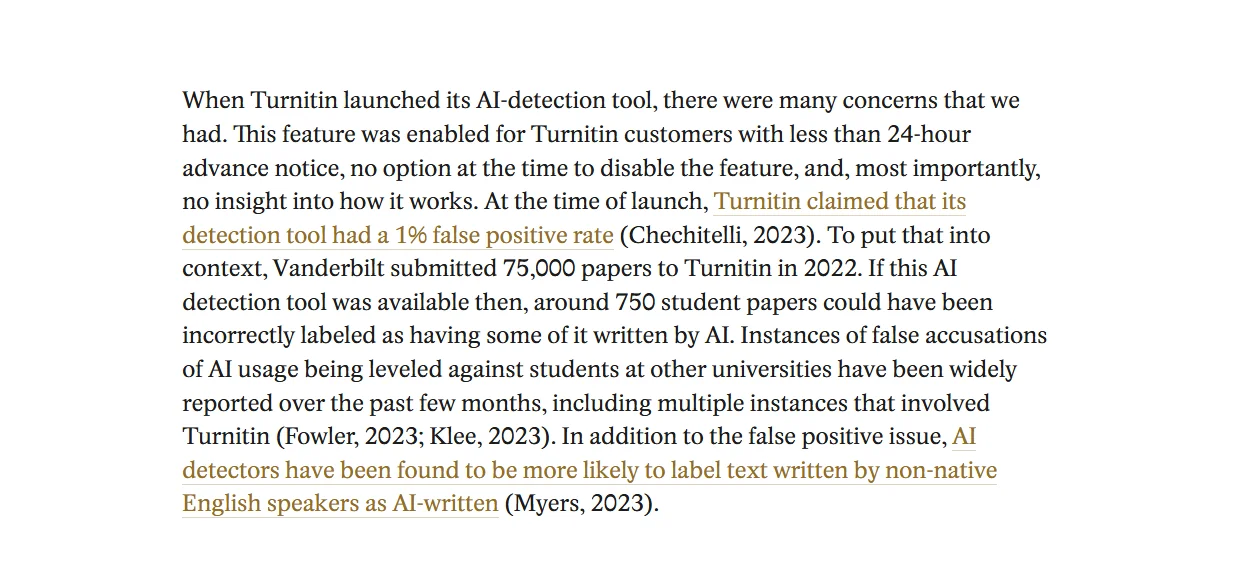
The Vanderbilt Bellwether — August 2023 Vanderbilt was the first major research university to publicly disable Turnitin AI detection. Its official notice calculated that even Turnitin's marketed ~1% false-positive rate could wrongly flag roughly 750 of the 75,000 papers submitted each year. The provost's office concluded the tool's risk-to-benefit ratio was unacceptable for disciplinary use.
Representative list of universities that DISABLED or restricted AI detection (2025–2026):
University | When | Public Reason |
|---|---|---|
Vanderbilt University | Aug 2023 | ~750 potential false flags per year; risk too high for discipline |
Johns Hopkins University | 2024 | Accuracy concerns |
Yale University | 2025 | Accuracy + fairness concerns |
Northwestern University | 2025 | Same |
Georgetown University | 2025 | Same |
Washington State University (WSU) | Feb 2026 | Cancelled Turnitin AI contract entirely |
UCLA + UC Berkeley | 2025–2026 | Restricted use; detectors not recommended as evidence |
University of Michigan | 2026 | Publicly stated detector tools "cannot provide definitive proof of cheating" due to high error risk |
University at Buffalo | 2025 | Same as Michigan |
University of Pittsburgh | 2025 | Equity and reliability concerns |
University of Iowa | 2025 | Same |
Cornell University | 2025–2026 | Deactivated centralized detection; moved to instructor-level judgment only |
Stanford University | 2023–2026 | Institutional non-use of AI detection |
Cal Poly SLO | 2023–2026 | Same |
Western University (Canada) | 2025–2026 | Same |
University of Waterloo (Canada) | 2025–2026 | Same |
Curtin University (Australia) | Jan 2026 | "Fostering trust and clarity within a modern academic culture" |
University of Cape Town (South Africa) | 2025–2026 | Fairness concerns |
University of Queensland (Australia) | 2025–2026 | Same |
Global tally: at least 61 universities across 4 countries have fully deactivated AI detection as of mid-2026.
2.4 Emerging State Legislation
Two US states passed laws in 2026 forcing formal AI policies at schools:
Ohio (HB 96): Requires all school districts to adopt a formal AI policy or follow a state-managed AI framework.
Virginia (SB 394): Parallel requirement for formal, division-managed AI policy frameworks. These laws effectively force institutions to document how they use (or don't use) AI detection and what due process exists.
3. Detection Results: Claims vs. Reality
3.1 The Accuracy Gap — Turnitin's Marketing vs. Independent Research
Metric | Turnitin's Official Claim | Independent Testing / Reality |
|---|---|---|
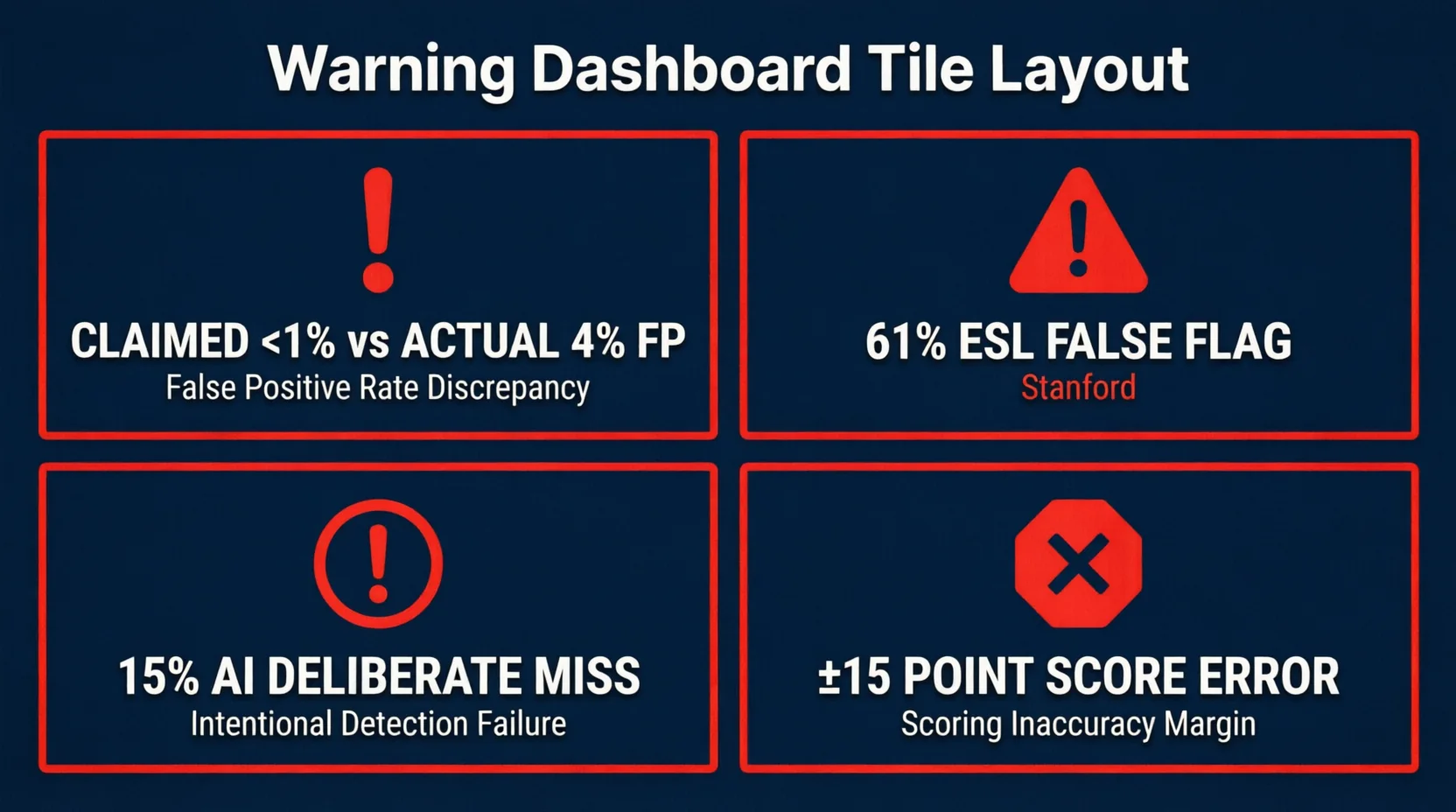
Document-level false-positive rate | < 1% (but only for documents with ≥20% AI-written content) | 4% at the sentence level — Turnitin's own acknowledged figure, meaning 1 in 25 human sentences is wrongly flagged. Washington Post real-world high-school testing found roughly 50% false flags. |
AI content miss rate | Not publicly advertised | Turnitin CPO openly admits the tool deliberately lets through approximately 15% of AI writing to keep false positives low. |
Overall accuracy | Marketed at "98%" | Independent 2026 testing pegs Turnitin at 85–90% accuracy overall, with the intentional 15% AI miss rate on one side and 4–50% false-positive variability on the other. |
ESL writer bias | Internal Turnitin paper: "no statistically significant bias against English Language Learners" | Stanford Liang et al., Patterns 2023: 61.22% of TOEFL essays (all human, non-native writers) were falsely classified as AI-generated across 7 commercial detectors. 19% unanimously misclassified by all 7 tools; 97% flagged by at least 1. Native-speaker essays: near-zero false flags. |
3.2 Who Gets Falsely Flagged — Three High-Risk Populations
① Non-Native English Speakers (ESL / ELL / International Students)
This is the single most well-documented fairness failure of AI detectors. The core mechanism is simple: AI detectors classify text based on perplexity (predictability of word choice) and burstiness (sentence-length variation). Non-native writers naturally produce vocabulary and sentence structures that are statistically more predictable — exactly the fingerprint detectors associate with machine generation.
Follow-up studies in 2024–2025 confirm that ESL submissions to Turnitin specifically are up to 30% more likely to be falsely flagged than native-speaker submissions on identical assignments.
Turnitin published an internal study claiming no significant bias, but it relied on a strict 300-word minimum threshold that many real student papers don't satisfy, and contradicted every major independent study published before and since.
② Neurodivergent Students (Autism, ADHD, Dyslexia, OCD)
Northern Illinois University research has documented elevated false-positive rates for neurodivergent students who tend to use repeated phrases, consistent and distinctive word choices, or highly structured communication patterns.
The Orion Newby / Adelphi University case (see Section 4 below) is the landmark example: a 100% AI flag on an autistic first-year student who had worked with a university-assigned tutor on the paper. Two other independent detectors (Grammarly, ZeroGPT) called it human-written. Adelphi refused to budge. A judge ultimately annulled the finding.
③ Highly Formulaic Academic Writing
Certain genres naturally look "AI-like" to statistical models because of their tight structure:
Lab reports (IMRaD format)
Legal briefs and IRAC memoranda
Nursing care plans
Engineering specifications
MBA case-analysis templates
The five-paragraph essay (the standard US high-school format, which GPT models default to exactly)
When thousands of students submit the same rigid template, the text converges on patterns detectors read as AI. Turnitin's own fine print warns that reliability degrades sharply whenever less than 20% of a document is flagged as AI — which is exactly the scenario formulaic student writing creates.
3.3 Racial Disparity Layer
Survey-level data suggests the false-positive problem has a racial dimension even beyond language background:
20% of Black teens report having been falsely accused of using AI on a school assignment
10% of Latino teens
7% of white teens
Black students are nearly 3× more likely to be wrongfully accused. When false flags lead to failing grades, transcript marks, or suspension records — they compound pre-existing educational inequalities.
3.4 The Deliberate Design Trade-off
Turnitin's chief product officer Annie Chechitelli has publicly confirmed the company made a conscious calibration choice: to keep document-level false positives below 1%, the algorithm intentionally permits approximately 15% of genuine AI writing to go undetected. Turnitin would rather "miss some AI writing" than wrongly accuse more human writers.
The result is a system that is simultaneously too aggressive on innocent students and too permissive on actual AI use — the worst of both worlds from a pure integrity standpoint.
4. Lawsuits and Turning Points: Students Fight False AI Accusations
By mid-2026, at least six formal US lawsuits have been filed by students disciplined off the back of AI detection claims.
Case | Court | Filed | Status / Outcome | Detector Involved |
|---|---|---|---|---|
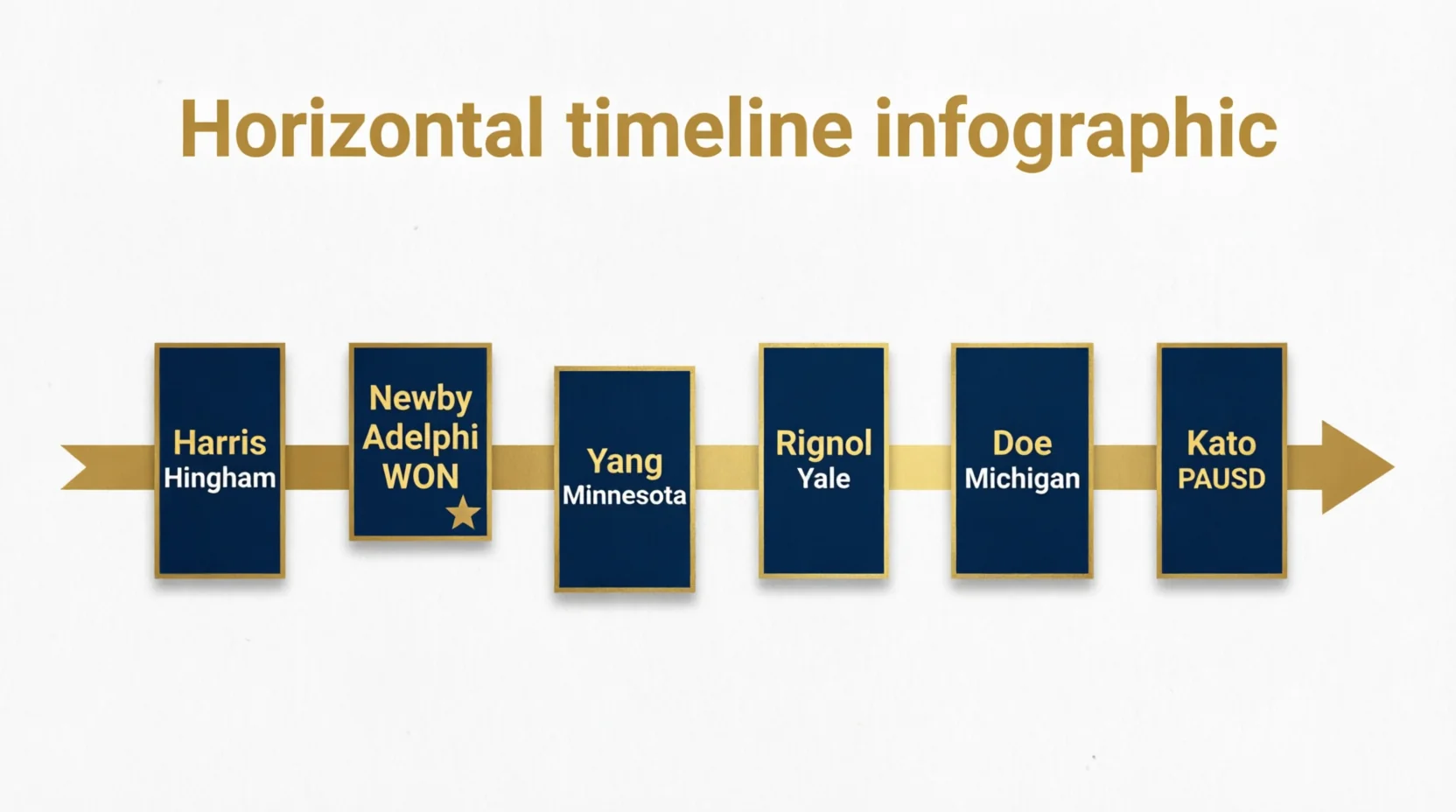
Newby v. Adelphi University | NY State Supreme Court, Nassau County (Article 78 proceeding) | Jul 2025 | DECIDED — STUDENT WON, Jan 2026. Misconduct annulled, record expunged. Judge called Adelphi's finding "without valid basis and devoid of reason." | Turnitin (100% AI flag) |
Harris (RNH) v. Hingham Public Schools | Federal, D. Mass. | Sep 2024 | Injunction denied — school prevailed so far. No final disposition confirmed. | Teacher judgment (not detector-alone) |
Yang v. University of Minnesota | State appeal + Federal, D. Minn. | 2025 | STUDENT LOST — expulsion affirmed / case dismissed | GPTZero + faculty judgment |
Rignol v. Yale University | Federal, D. Conn. | Feb 2025 | Pending (injunction denied) | GPTZero (EMBA student, 1-year suspension) |
Doe v. University of Michigan | Federal, E.D. Mich. | Feb 2026 | Pending (injunction denied) | Not named in public docket |
Kato v. Palo Alto Unified School District | Federal, N.D. Cal. | May 2026 | Newly filed, pending. Family submitted 1,162-page evidence packet of Google Docs revision history. | Turnitin (76% AI flag) |
Scoreboard: 1 clean student win, 2 school wins, 3 pending. No court has yet ruled that an AI detector is itself unlawful — every decision so far has turned on due process (fair hearing, consideration of contrary evidence, adherence to the institution's own written procedures), not on the scientific validity of detection technology.
Spotlight: Two Defining Cases
Orion Newby v. Adelphi — The First Student Win Orion Newby, a first-year autistic student in Adelphi's Bridges support program, wrote a World Civilizations paper with help from a university-assigned tutor. Turnitin flagged it 100% AI. Two other independent tools (Grammarly and ZeroGPT) said human. Newby offered draft histories and tutor testimony. Adelphi's integrity board still upheld the charge. A New York State Supreme Court judge annulled the finding and ordered the record fully expunged.
Crucially: this was a state-level Article 78 proceeding, not a federal case — and it was about a broken disciplinary process, not a ruling on Turnitin itself. Still, it is the single most cited precedent in student-rights circles because it explicitly rejected the idea that a 100% Turnitin score can substitute for a real investigation.
Kato v. PAUSD — The 1,162-Page Evidence Packet A 10th-grade student at Palo Alto High wrote an essay on Arthur Miller's The Crucible. Turnitin flagged it 76% AI. The teacher required the student to rewrite it in class under supervision; the grade fell from A/B range to a C. The family submitted more than 1,100 pages of Google Docs revision history, drafts, and timestamped workflow artifacts to the district to prove authorship. The district refused to reverse the grade. The case is now in U.S. District Court for the Northern District of California.
What Lawsuits Are Already Forcing Schools to Change
Virtually every university that updated its AI policy in 2025–2026 now explicitly requires:
AI percentage alone is not sufficient evidence for discipline.
Multiple forms of evidence (drafts, version history, oral questioning, writing samples) must be considered.
A formal appeals pathway must exist with documented procedures.
Faculty must receive AI-detector-limits training.
Turnitin itself, in a February 2026 strategy announcement, declared a shift "from detection to transparency," launching features that let instructors see how a document was written over time rather than just judge the final score.
5. The Spectrum of Reactions
5.1 Arguments for Keeping Detection
Integrity management at scale: Without any detection tool, academic integrity enforcement becomes functionally impossible in large-enrollment classes with hundreds or thousands of students.
Better-than-nothing: Even with flaws, Turnitin is the most accurate general-purpose detector on the market. OpenAI's own classifier caught only 26% of AI text and mislabeled 9% of human text before it was shut down entirely in July 2023.
Changing behavior: A visible deterrent effect. Even imperfect detection changes how students approach assignment integrity.
Supporting vulnerable students: Paradoxically, some student-affairs staff argue, a detector that triggers a conversation (rather than automatic punishment) can surface students who are genuinely struggling or don't understand academic-integrity rules — enabling intervention instead of penalty.
5.2 Arguments for Abandoning Detection
Top-10 consensus: None of the Top 10 US National Universities publicly uses AI detection for coursework discipline. If the most selective institutions walk away, that signals a professional consensus on the tool's unreliability.
61% ESL false flag rate: No integrity system can claim legitimacy when it misclassifies three in five genuine essays written by non-native speakers.
Intersectional harm: ESL + neurodivergent + racial disparities create compounded over-policing of already marginalized student populations.
Pedagogical chilling effect: Students report writing to "satisfy the algorithm" instead of writing for clarity, creativity, or persuasion. Perplexity and burstiness optimization replaces actual thinking.
Evidence-based alternatives exist: Authentic assessment redesign, process-based verification, portfolio comparison, and oral defenses all have significantly better track records and don't punish students for their writing style.
Edward Watson, AAC&U Vice President for Digital Innovation: "At most, AI detection tools should serve as an auxiliary reference in academic integrity investigations. An instructor must never treat an AI detection result as definitive evidence or what some call 'ironclad proof.'"
5.3 The Replacement Toolkit: What Schools Use Instead
Universities that turn off detection overwhelmingly shift to three assessment redesign patterns:
Alternative | How It Works | Why It Beats Detection |
|---|---|---|
Process-Based Assessment | Require outlines, multiple drafts, Google Docs revision history, browser timestamps. Evaluate "how the paper was written," not just the submission. | Catches actual AI authorship (because AI drafts show no iterative human history) while rewarding genuine effort. |
Portfolio / Baseline Comparison | Keep earlier verified writing samples on file; compare new submissions against a student's own established writing fingerprint. | Does not rely on generic AI training data; the comparison is student-to-self. |
Oral Examinations / Viva Voce | Short in-person or synchronous questioning about the paper: thesis, citations, argument structure, counterarguments. | The single most reliable differentiator between "wrote it yourself" and "AI ghost-wrote it" — a student can talk convincingly about their own ideas in ways no AI-generated paper alone can reveal. |
6. Quick Reference Data Tables
6.1 Adoption Headline Numbers
Metric | Figure |
|---|---|
Global Turnitin AI institutions | 16,000+ |
US 4-year university activation rate (Fall 2025) | ~80% |
Top-50 US National Universities with AI clearly ON | 2 (Georgia Tech, UGA) |
Top-50 US National Universities with AI OFF / unused | 35 (70%) |
Top-50 undisclosed setting | 13 (26%) |
CSU System total Turnitin spend, 2025 | $1.1M+ |
CSU AI detection add-on spend, 2025 | $163K |
Universities globally that fully disabled AI detection | 61+ across 4 countries |
6.2 Student AI Usage (US Higher Ed, Oct 2025 – Apr 2026)
Data Point | Percentage |
|---|---|
Submissions with >80% AI score (United States) | 19.4% |
Same statistic, United Kingdom | 9.8% |
Same statistic, Australia | 10.2% |
US K-12 equivalent (same >80% AI threshold) | 5–6% |
6.3 Accuracy and False-Positive Matrix
Finding | Figure | Source |
|---|---|---|
Turnitin claimed document false positive (≥20% AI docs) | < 1% | Turnitin FAQ, official |
Turnitin acknowledged sentence-level false positive | 4% | Turnitin blog, June 2023 |
Turnitin AI writing deliberately missed (calibration choice) | ~15% | Turnitin CPO public remarks |
Washington Post real-world high-school false-positive test | ~50% | Washington Post |
ESL TOEFL essays falsely called AI (7 detectors, Stanford) | 61.22% | Liang et al., Patterns 2023 |
ESL unanimously misclassified (all 7 detectors) | 19% | Same study |
Turnitin ± margin of error on percentage score | 15 pts | Detection Drama + Turnitin guides |
Black teens reporting false AI accusation | 20% | Race-equity survey data |
White teens reporting false AI accusation | 7% | Same survey |
7. Conclusion
The state of Turnitin AI detection in American schools is a fast-moving story. Four headline conclusions stand out:
① Broad adoption, but elite-university rejection. Eighty percent of four-year institutions technically run Turnitin AI — yet the most prestigious universities are fleeing it. Among the Top 50 US National Universities, only two keep it clearly enabled; 35 have turned it off. The bigger, more automation-dependent a school is (community colleges, online programs, large state systems), the more heavily it still relies on detection.
② Institutional consensus: an AI score is not proof. Whether a school keeps detection on or off, the updated policy language has converged nationwide: a Turnitin AI percentage, by itself, cannot support a disciplinary finding. It must be paired with multiple other forms of evidence — drafts, revision history, writing samples, oral questioning. The Newby v. Adelphi decision cemented this principle when a judge annulled a 100% AI finding because the university skipped real investigation.
③ Accuracy has a severe, documented demographic problem. Turnitin's raw accuracy looks acceptable on native-speaker, free-form prose. But it fails catastrophically on the populations the system already under-serves: non-native English speakers (61% false flag rate in the Stanford study), neurodivergent students, highly formulaic writers, and — by survey proxy — Black and Latino students. This systemic bias remains the single strongest reason universities give for walking away.
④ Simple prompt rewriting cannot bypass Turnitin AI detection. Both peer-reviewed literature and real classroom cases confirm that superficial prompt adjustments — adding "write like a human," varying sentence length instructions, running AI text through a second paraphrasing pass — do not meaningfully lower Turnitin AI scores. Turnitin detects deep statistical patterns in vocabulary choice and syntactic structure, not surface rhetorical style. The techniques that do reliably reduce scores (character-level perturbation, 30%+ manual rewriting, back-translation chains) either destroy text quality or amount to the student simply rewriting the work themselves.
The ultimate consensus now forming inside US higher education is that academic integrity in the AI era cannot be policed by a black-box classifier. The sustainable path is the shift from detection orientation to process orientation: valuing the writing journey, multiple sources of evidence, faculty-student conversation, and authentic task design. Whether every institution gets there before more false-flag lawsuits force the issue remains to be seen.