Community College Turnitin AI Policy: Students' 2026 Guide

Short answer: California Community Colleges — 73 districts, 116 colleges, about 2.1 million students, the largest system of its kind in the US — spent 2025 rolling Turnitin's AI writing detection out across campuses, while the state's student senate pushed for one set of guidelines. Nationally, roughly 80% of four-year universities already enable the AI module, and community colleges are following fast. You can't buy a report from Turnitin directly, but US students are eligible for one free real-Turnitin check at InDetect, our service, and paid plans start at $9/month for two checks ($4.50 each). Here's how to find out if your course runs it, what the score bands trigger, and how to check before you submit.
A note on authorship. This comes from the team at InDetect. We're an independent pre-submission checker — not affiliated with Turnitin — that runs your paper through authorized instructor accounts with zero repository storage. We recommend our own service in section 5, so factor that in; the spending and policy facts are cited to their original reporting.
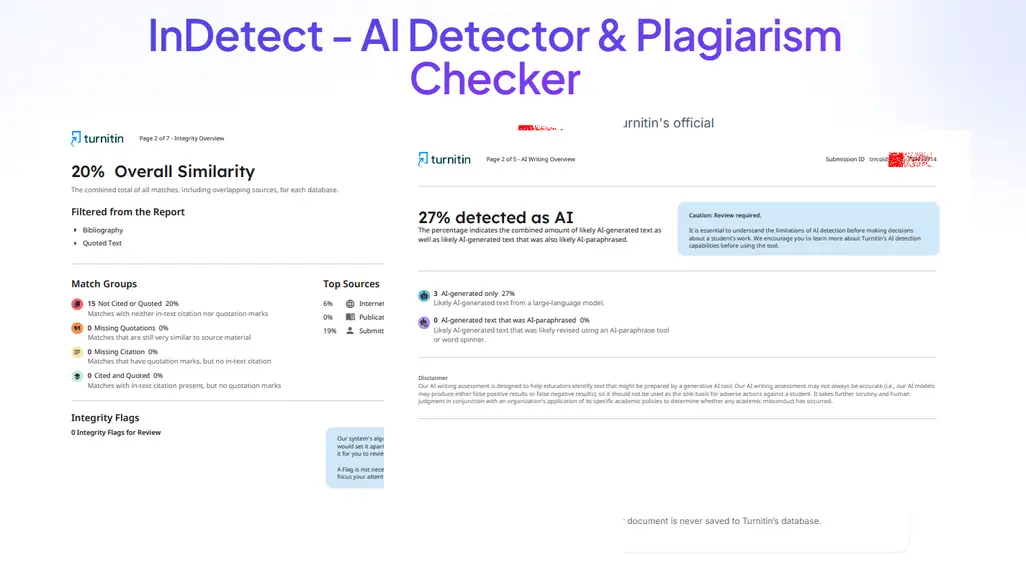
Key Takeaways
The California Community Colleges system spans 116 colleges and about 2.1 million students, and 2025 saw Turnitin AI detection spread across campuses — but not through one system-wide switch.
Whether the AI module runs on your essay is set course by course; your syllabus or instructor can confirm it in one email.
California pays real money for this: the CSU system spent $1.1M on Turnitin in 2025, including $163K specifically for the AI add-on.
Community college essays carry extra false-positive risk — transfer writing styles and five-paragraph templates flag easily, and non-native speakers are misclassified at high rates.
US students get one free real-Turnitin report at InDetect; after that, Lite is $9/month for two checks ($4.50 each).
1. Is Your Community College Running Turnitin AI Now?
Start with the scale, because it's well documented: the Chancellor's Office lists 73 districts and 116 colleges serving about 2.1 million students. Through 2025, Turnitin's AI detection rolled out widely across CCC campuses. Be precise about what that means, though: we found no public evidence of a single system-wide activation, and the student body is still fighting for basic consistency. The California Student Senate for Community Colleges passed resolution S25.24.30, calling for statewide guidelines on AI detection software, after the Chancellor's Office spent 2024 discussing tools including Turnitin without publishing rules for students.
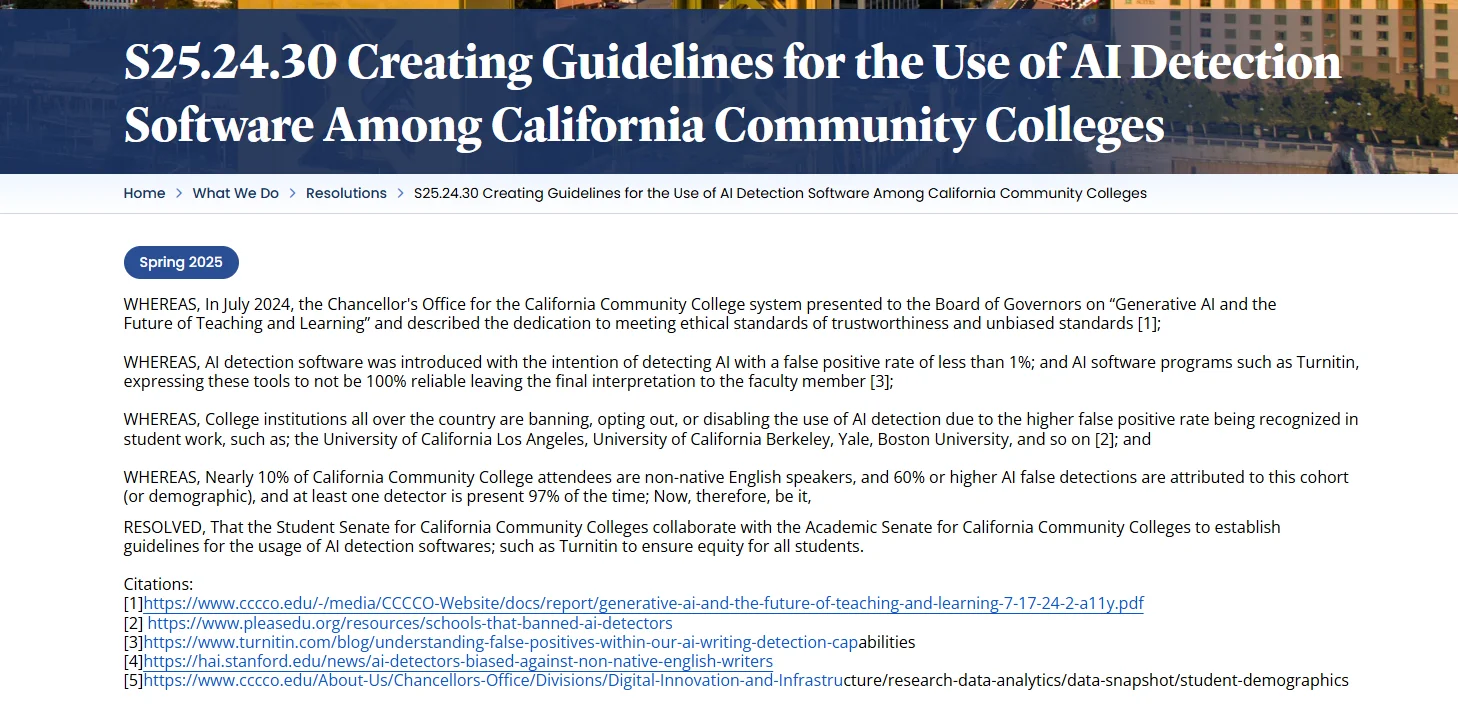
So "is it on for me?" is a per-course question. Three checks tell you where you stand: read your syllabus for AI-detection language; look at the assignment page in Canvas or Blackboard for an AI report setting; email your instructor. Nationally the direction of travel is clearly on — about 80% of four-year universities enable the AI module, a figure we track with sources in our US schools adoption guide. It's not one-way, either: a growing list of US institutions have disabled or restricted the module, which we keep current in universities that disabled Turnitin AI detection.
2. Why Community Colleges Lean on AI Detection More Than 4-Year Schools
Community colleges are structurally exposed in a way flagships aren't. Classes are large — 40-plus students per section is routine. Online and hybrid programs carry a big share of enrollments. And most CC instructors have no in-person writing supervision: no proctored drafts, no workshop check-ins. A detector is often the only authorship signal they get, which is exactly why they buy it.
The money follows the anxiety. The Markup's June 26, 2025 investigation of California colleges' spending found the CSU system alone paid $1.1M for Turnitin in 2025 — including $163K specifically for the AI detection add-on module. CSU is the four-year system, but the purchase shows what California institutions are paying for and how fast the AI line item grew.
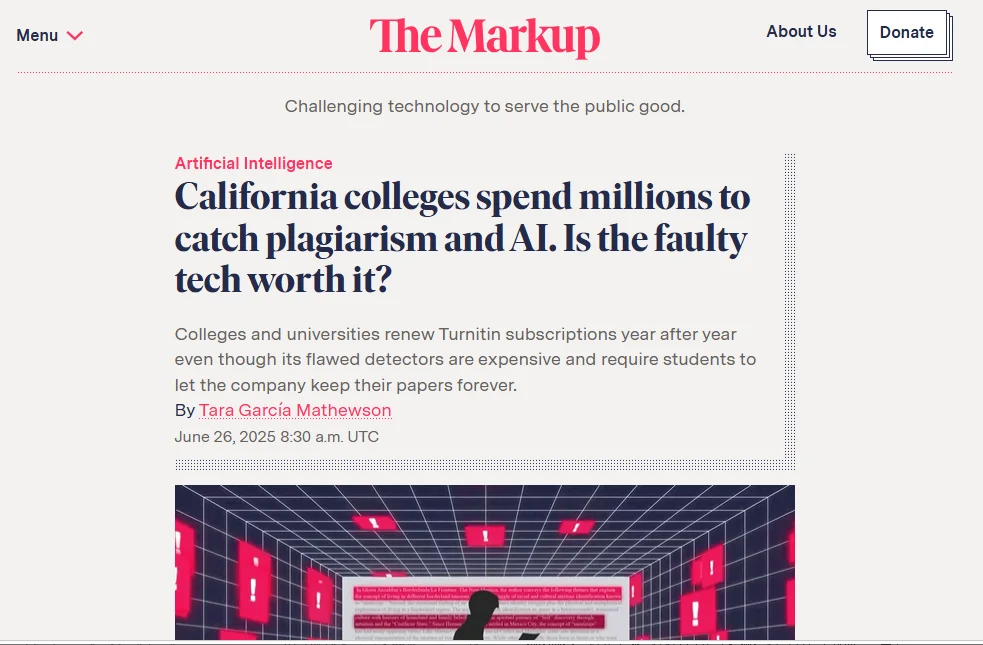
For you, the consequence is simple: detection is being bought, deployed and trusted at scale, and a short community college essay is exactly the kind of writing detectors handle worst.
3. What AI Scores Trigger Action at a Community College
There's no official national threshold — instructors set their own reactions — but this is how the bands generally play out on real reports, based on Turnitin's own banding and common practice:
| AI score | What it usually means |
|---|---|
| 0–10% | Reads as human; no action |
| 11–20% | Gray zone; often displays as a *% instead of a number |
| 21–40% | Most instructor follow-ups start here — a conference, not a charge |
| 41–60% | Formal inquiry likely; expect to show drafts |
| 61–100% | Treated as serious; misconduct process possible |
Two caveats before you anchor on a number. Turnitin discloses a ±15-point error margin, so your "28%" could be a 13% paper or a 43% one. And the *% display in the 11–20 band confuses almost everyone — our asterisk score explainer covers what it hides and why it isn't automatically a pass.
4. False-Positive Risks CC Students Should Know About
Three things make community college essays a detector's weak spot.
Non-native English. The Stanford-led Liang et al. study (Patterns, 2023) found that 61.22% of flagged essays by non-native speakers were misclassified as AI — human writing, wrong verdict. If English is an additional language for you, careful, grammatical prose is statistically more likely to be flagged, not less.
Transfer writing habits. You arrive trained to write one way and get assessed by software tuned on another. Style shifts between high school and college writing confuse authorship assumptions, and a detector sees "changed voice" where you see "I adjusted to feedback."
The five-paragraph template. It's the standard shape of US high school writing: topic sentence, three supports, conclusion. Clean, formulaic, heavily structured — exactly the patterns detectors associate with models. Writing "well-organized" by textbook rules can read as machine output.
The fix isn't to write sloppier. It's to keep evidence — dated drafts, version history, your outline — and to see your real score before the deadline. International students in Australia hit the same bias at even larger scale; our Australia guide covers that data.
5. Affordable Pre-Check Options for Community College Students
Here's the cost math nobody puts plainly: Turnitin doesn't sell you anything directly. Your options are asking your instructor for a look (rarely granted), guessing, or using a third-party service that runs the real engine through an authorized instructor account. That last one is InDetect, and it's built for exactly this budget.
US students are eligible for one free check for eligible new users (availability depends on your country at signup). Upload a PDF or DOCX, wait 5–30 minutes, and you get the same similarity + AI report your instructor will see. The paper runs in zero-repository mode — it won't match itself when you submit — and both the paper and the report are deleted within 24 hours.
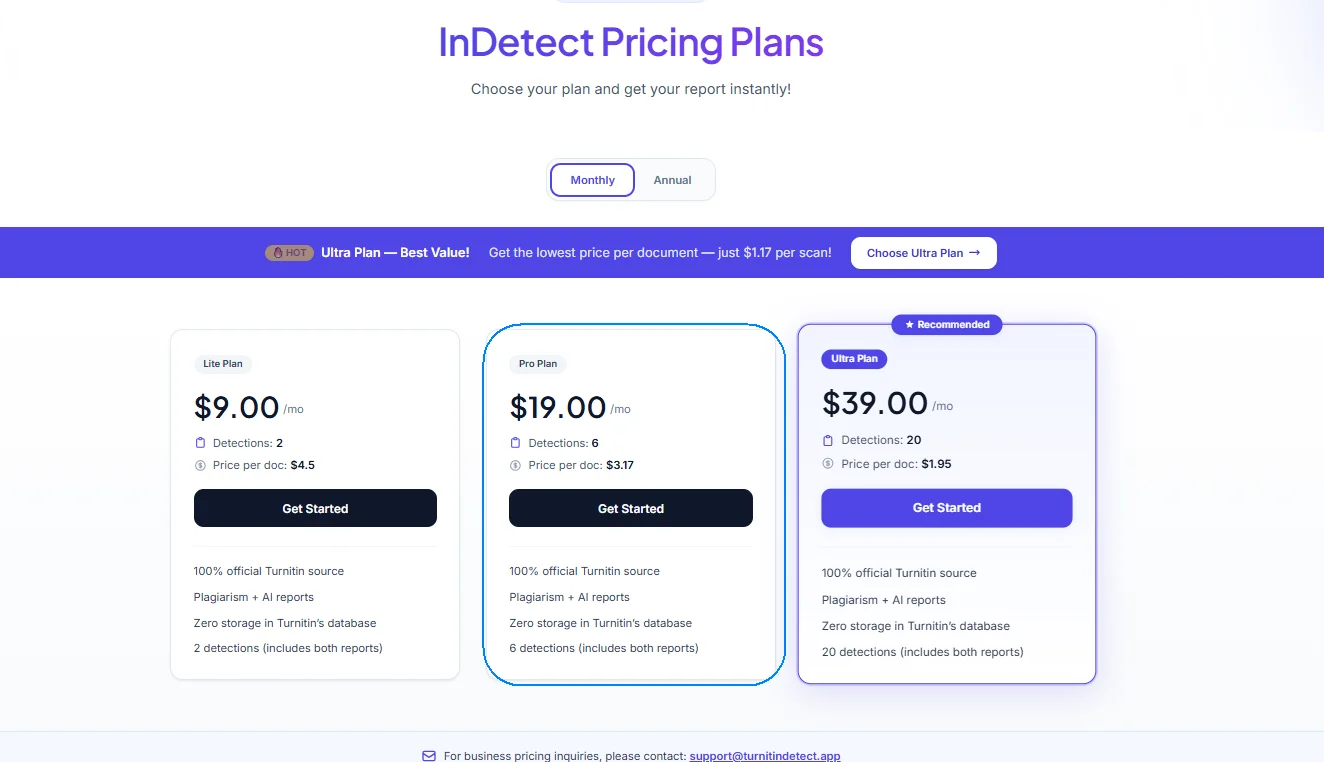
If you're carrying multiple courses, pricing is subscription-only: Lite is $9/month for 2 checks ($4.50 each), Pro is $19/month for 6 checks ($3.17 each), Ultra is $39/month for 20 ($1.95 each). Annual billing saves about 40%. Every check includes both reports. A $3.17 check is cheaper than one dropped grade, and there's no humanizer upsell at the end, because we don't sell one.
6. FAQ: Community College Students on Turnitin AI
Do community colleges use Turnitin AI detection? Many do, and the share is growing — roughly 80% of US four-year universities already enable the AI module, and CC campuses are following. But it's set course by course, so confirm with your syllabus or your instructor.
Does California Community Colleges use Turnitin AI? Turnitin AI detection spread widely across the 116-campus CCC system during 2025, and the state student senate is pushing a single set of guidelines. We found no evidence of a blanket system-wide activation, so check your own college before assuming.
How much does a Turnitin report cost for a community college student? Turnitin sells to institutions, not students. At InDetect, US students get one free check as new users; after that, Lite is $9/month for two checks ($4.50 each) and Pro is $19/month for six ($3.17 each).
Can I check my Turnitin AI score before submitting without a class ID? Not on Turnitin itself — there's no student self-serve. A pre-check service routed through an authorized instructor account gives you the real report without a class ID; that's what the free first check above is.
Will checking my essay first make it show up as a match later? No, if the check runs in zero-repository mode like InDetect's. Your paper isn't stored in Turnitin's database and can't match itself at submission; we delete the paper and report within 24 hours anyway.
7. Check Once, Submit Confident
You don't need to guess whether your essay will flag. Confirm your course's settings, keep your drafts, and spend ten minutes getting a real report before the deadline. US students are eligible for one free check at InDetect. If you've got more than one paper this term, Lite at $9/month covers two.