Turnitin AI Detection Adoption in US Universities (2026)

Last updated: October 25, 2026. This page is refreshed every US semester (January and September); the change log is at the bottom.
Direct answer — Turnitin still holds the dominant deployment in US higher education: 16,000+ institutions worldwide use its AI writing detection (the company's January 2026 figure, including 4,000+ US institutions), and roughly 80% of four-year universities had the module switched on by fall 2025. But the 2026 picture is best described as "adopted, doubted." At least 61 universities across four countries have switched the feature off, six student lawsuits have reshaped discipline procedures, and most updated policies now treat an AI score as the start of a conversation — not the verdict. Every number on this page carries a source and a date, and we re-check them each semester.
A note on authorship. This data page is compiled by the team behind InDetect, a third-party pre-submission checker that runs the real Turnitin engine through authorized instructor accounts. We're not a neutral observer — students who care about these numbers are our customers. We try to earn the trust anyway: sources named, dates attached, no spinning in either direction.
Key Takeaways
Scale: 16,000+ institutions globally (Turnitin, Jan 2026); ~80% of US four-year universities enabled by fall 2025; community colleges followed in spring 2026.
Direction: adoption is deepest where in-person verification is impossible — online programs, community colleges, large state systems — and thinnest at the most selective schools.
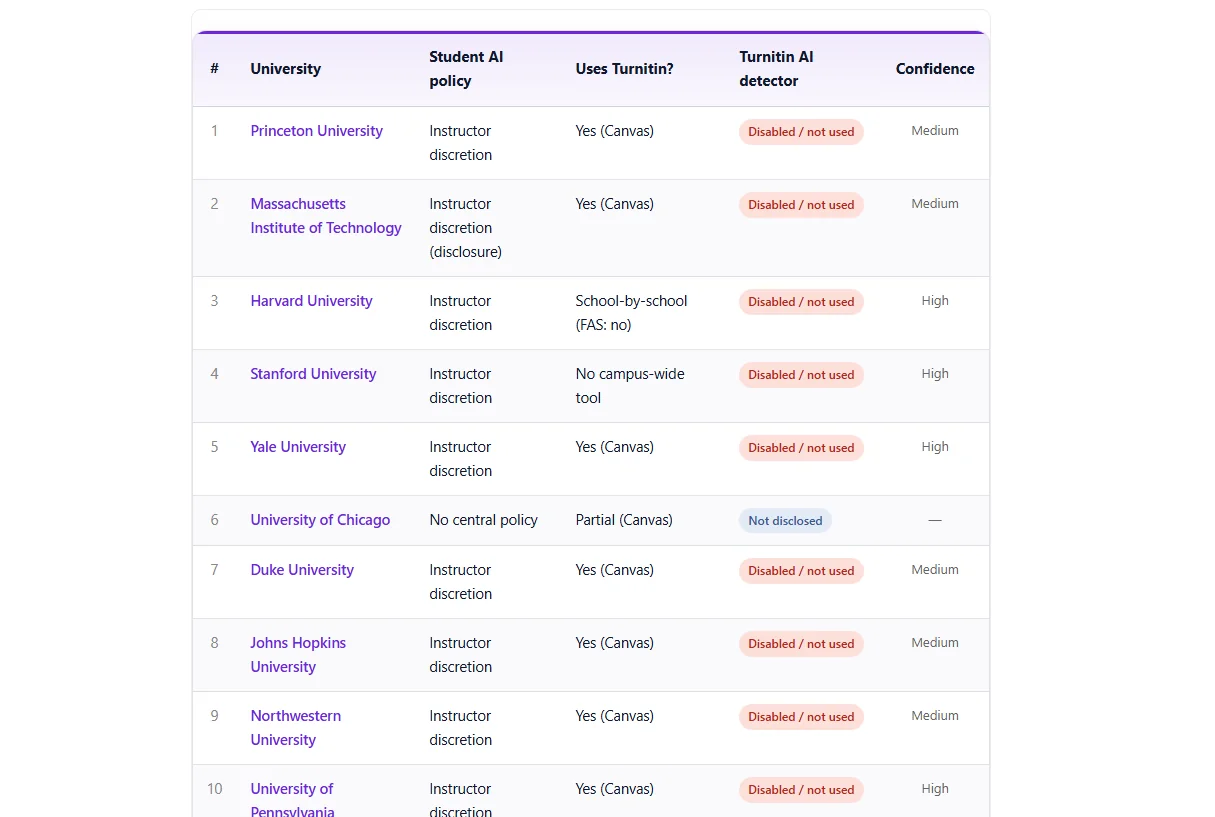
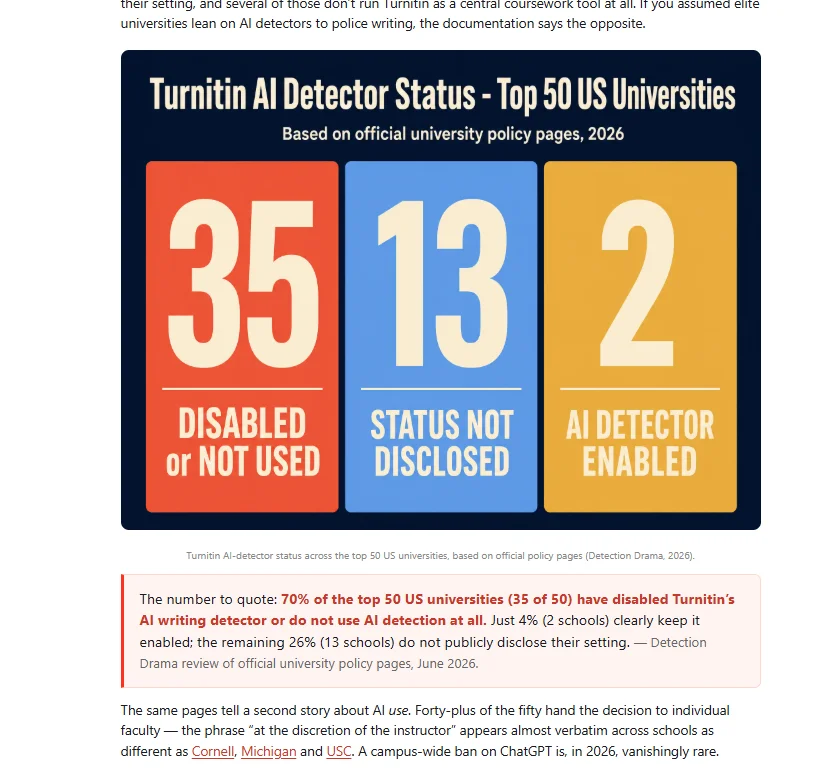
Pushback: 35 of the US Top 50 public universities (70%) have disabled AI detection or don't use it; only Georgia Tech and UGA explicitly kept it on.
Lawsuits: six tracked student cases, one student win (Newby v. Adelphi, Jan 2026); courts rule on procedure, never on the detector itself.
Policy: the consensus language now is that an AI score alone can't justify discipline — but a professor's report still shows that score, to that professor.
1. How Widely Is Turnitin Used in US Schools?
The timeline, with sources and dates:
April 2023 — Turnitin ships AI writing detection and enables it by default for roughly 10,700 institutions; schools had to opt out.
Fall 2025 — over 80% of US four-year universities have the module active. California's community college system (116 colleges, 1.8M students) fully enabled it in 2025, and community colleges nationally followed in spring 2026.
January 2026 — Turnitin announces 16,000+ institutions globally using the feature, including 4,000+ in the US.
2025 spending — the California State University system alone spent $1.1M+ on Turnitin, with $163K attributable to the AI add-on module.
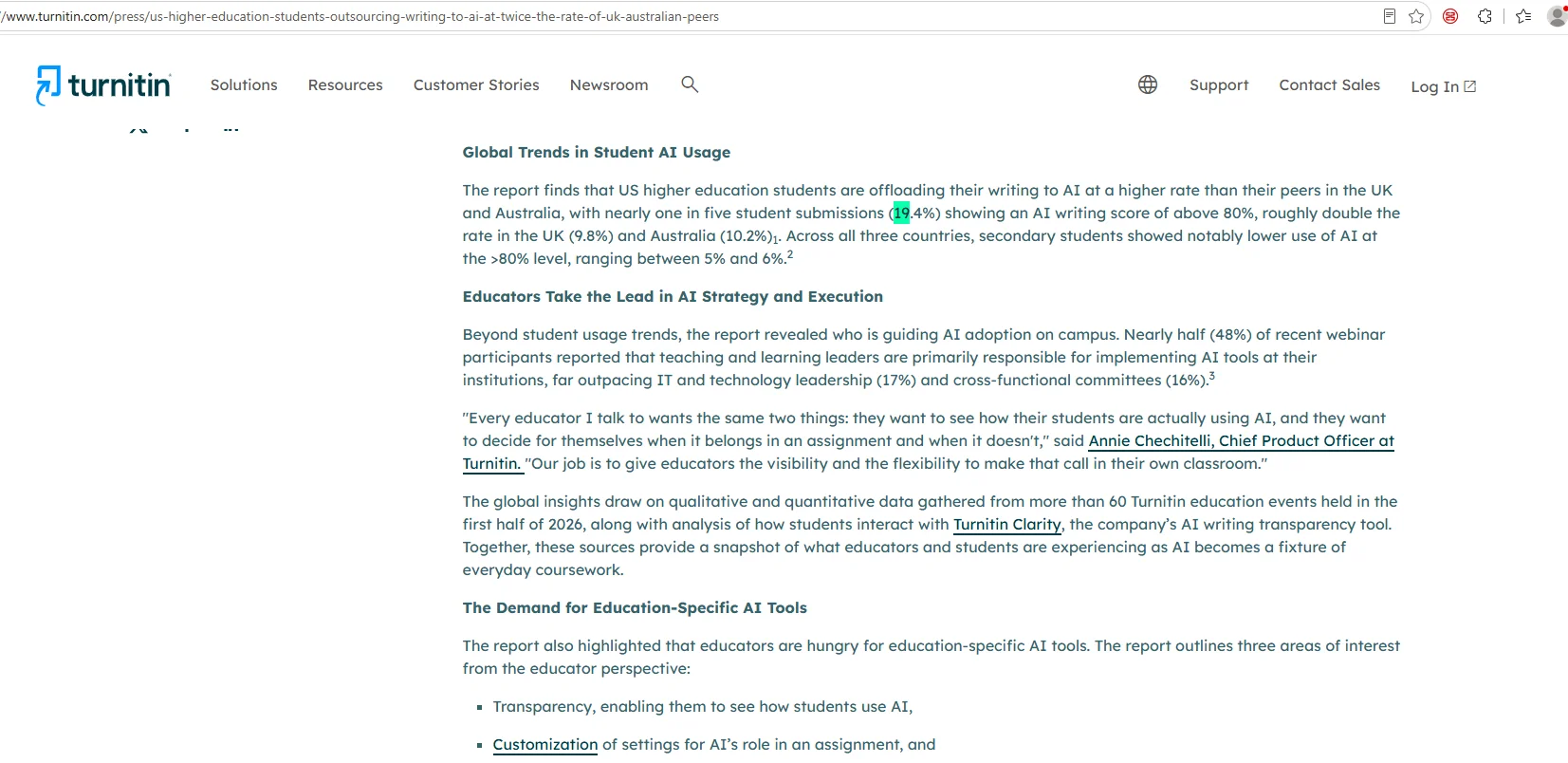
Demand-side data backs up why schools bought in. Turnitin's July 2026 Learning Integrity Insights report analyzed 33M US submissions (Oct 2025–Apr 2026): 19.4% of US higher-ed submissions scored above 80% AI — roughly double the UK's 9.8% and Australia's 10.2%. K-12 sits at about 5–6%.
The pattern is consistent: the less a school can verify writing in person, the harder it leans on detection. That's exactly why the most selective campuses — small seminars, oral defenses, in-class essays — started walking it back.
2. Universities That Disabled or Paused AI Detection
The withdrawal started as a trickle and became a wave:
| When | School | What happened |
|---|---|---|
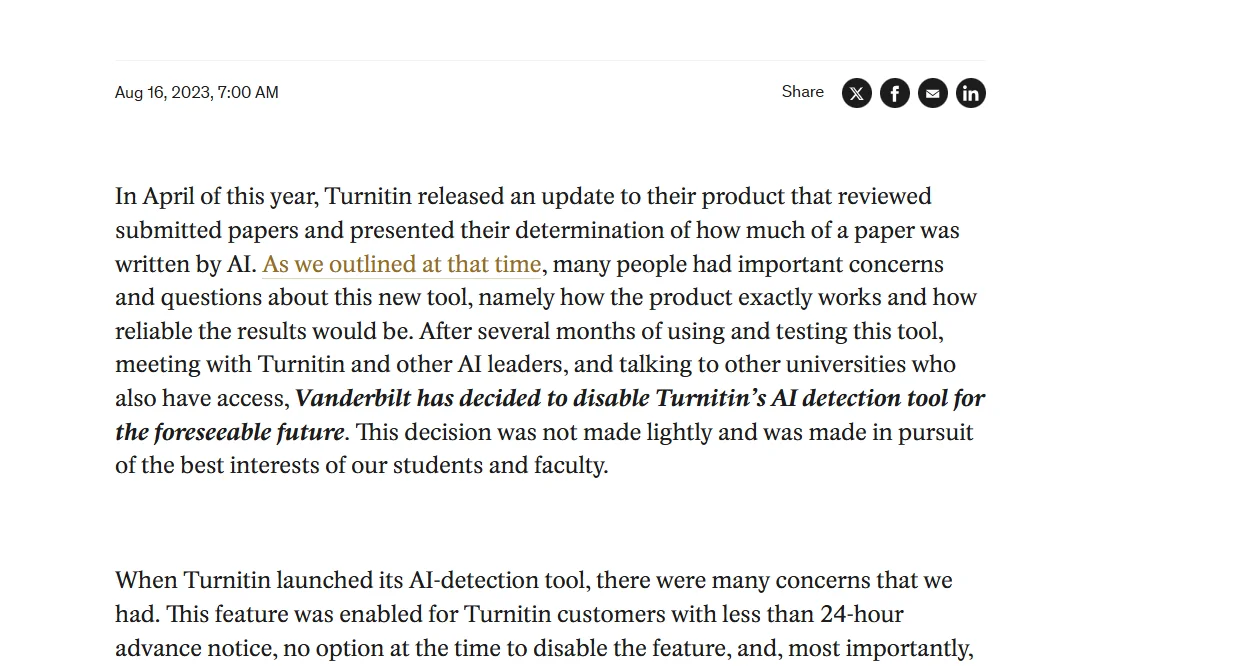
| Aug 2023 | Vanderbilt | First institution-level disable; cited ~750 wrongly flagged papers/year at a ~1% false-positive rate |
| 2024 | Johns Hopkins | Disabled over accuracy issues |
| 2025 | Yale, Northwestern, Georgetown, Buffalo, Pitt, Iowa | Disabled, citing accuracy and fairness |
| 2025–2026 | Cornell, Stanford, UCLA, UC Berkeley | Ended centralized use; restricted as evidence or left to instructor judgment |
| Feb 2026 | Washington State | Canceled the Turnitin AI contract outright |
| 2026 | Michigan | Policy statement: AI detection "cannot provide definitive proof of cheating" |
That's the US headline set. The full A-Z list — 61+ schools across the US, Canada, Australia, and South Africa, each with a stated reason and verification date — lives in our companion page, Universities That Disabled Turnitin AI Detection. The original deployment survey behind these numbers is our data page on Turnitin AI detection in US schools.
3. The 2026 Lawsuits and What Changed After Them
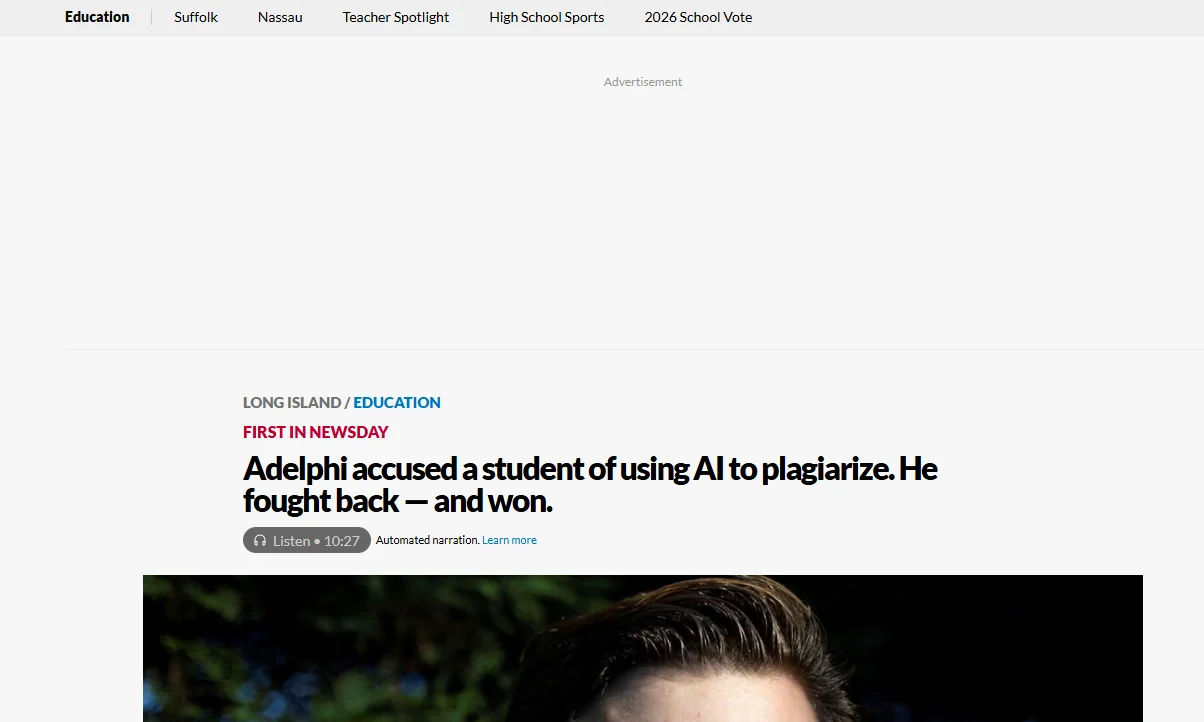
Six student or family lawsuits over AI-based discipline have been filed in US courts since 2024. As of October 2026: one student win (Newby v. Adelphi, decided January 28, 2026 — the court called the accusations "completely false" and ordered the record expunged), two school-side wins (Harris v. Hingham, Yang v. Minnesota), one voluntary dismissal (Kato v. PAUSD, dropped September 2, 2026, with no disclosed reason or settlement terms), and two pending (Rignol v. Yale, Doe v. Michigan).
No court has ruled on whether an AI detector is lawful or reliable. Every decision turned on due process: hearings held, counter-evidence weighed, the school's handbook followed. The practical effect moved faster than the law — evidence standards tightened and appeal channels formalized at most schools that updated policy in 2025–2026. Our lawsuit tracker keeps the case board current.
4. Policy Shift: From "Score = Verdict" to "Score = Conversation"
Compare a 2024 integrity policy with its 2026 rewrite and the language change is obvious. Current policies at most large institutions include four elements: an AI score can't be the sole basis for discipline; it must be corroborated by drafts, version history, or oral explanation; a formal appeal path exists; and instructors get training on detector limits. Policy-audit trackers like Detection Drama document this across the Top 50.
Even Turnitin changed its story: a February 2026 pivot "from detection to transparency," shipping features that show how a document evolved rather than only a final percentage. One honest caveat: policy language moves faster than practice. A professor who trusts the number can still act on it — "conversation" is what the handbook promises, but the report still opens with a percentage.
5. Accuracy Debate in 2026: Official Claims vs Independent Research
The gap between what Turnitin publishes and what researchers measure, in one table:
| Metric | Turnitin's position | Independent / disclosed reality |
|---|---|---|
| Document-level false positives | <1% (only claimed for documents ≥20% AI) | Washington Post high-school field test: ~50% of human essays flagged |
| Sentence-level false positives | 4% (acknowledged) | — |
| Missed AI text | Not published | ~15% deliberate, per CPO Annie Chechitelli — a trade to cut false positives |
| Overall accuracy | 98% (marketing figure) | 85–90% in independent tests |
| ESL students | No statistically significant bias (internal) | Stanford 2023: 61.22% of 91 genuine TOEFL essays flagged by ≥1 of 7 detectors |
| Error margin | ±15 percentage points, disclosed | Scores under 20% hidden as *% — the company's own low-confidence band |
Sources: Turnitin product documentation and public statements (2023–2026); Liang & Zou, Stanford (2023); Washington Post testing (2024); verified October 25, 2026. For what this looks like on real AI-generated drafts, our hands-on test of Gemini, ChatGPT, and Claude against the engine is the companion data.
6. What This Means for Students Submitting This Semester
Three moves, in order:
Read your school's actual policy, then your syllabus. Institution-level "disabled" often still allows instructor discretion. If the syllabus is silent, email the professor and keep the reply.
Keep process evidence from day one. Version history, dated drafts, notes. Post-accusation evidence packets — the Kato family's 1,162 pages — have a worse track record than pre-accusation habits.
Know your number before the deadline. Policy mood doesn't change the report your professor sees. InDetect runs your paper through the real Turnitin engine via authorized instructor accounts — no affiliation with Turnitin, zero repository storage so nothing matches itself later, papers and reports deleted within 24 hours, results in 5–30 minutes. US students are inside the eligibility list: one free check for eligible new users (availability depends on your country), or Lite at $9/month for 2 checks ($4.50 per paper).
7. FAQ: Turnitin Adoption in US Universities
Do most US universities use Turnitin AI detection? At the platform level, yes — roughly 80% of four-year universities had the module enabled by fall 2025, and 4,000+ US institutions use Turnitin's detection overall. But in the Top 50 public universities, only two (Georgia Tech and UGA) explicitly keep it on, and 35 have disabled or never adopted it.
Which universities turned off Turnitin AI detection in 2026? Washington State canceled its Turnitin AI contract in February 2026, and Michigan published its "cannot provide definitive proof of cheating" statement the same year. The wider wave — Vanderbilt, Yale, Stanford, Cornell, UCLA, and 50+ others across four countries — is itemized with dates in our A-Z list.
Can a school expel a student based only on a Turnitin AI score? Policies say no, and the one decided lawsuit agrees: Newby v. Adelphi vacated a finding over process failures around the score. In practice, an AI percentage still starts investigations — and investigations still cost grades.
Are there lawsuits against Turnitin AI detection? Six tracked cases as of October 2026, all filed against schools or districts rather than Turnitin itself: one student win, two school wins, one dropped (Kato v. PAUSD, September 2, 2026), two pending. Courts are ruling on due process, not detector science.
How accurate is Turnitin AI detection according to US schools? Schools that published reasons cite a ~1% document-level false-positive rate (Vanderbilt's estimate, ~750 flagged papers a year at their volume), a ±15-point error margin, and the Stanford finding that 61.22% of genuine ESL essays got flagged. Turnitin's own marketing claims 98% accuracy; independent tests land at 85–90%.
8. Refresh Log
We update this page every US semester. The log below records what changed, so you can judge how current any number is.
| Updated | New disabled/paused schools | Lawsuit developments | Adoption changes |
|---|---|---|---|
| Oct 25, 2026 | Baseline set: 61+ across 4 countries; 35 of Top 50 off | Newby decided (student win, Jan); Kato dropped (Sep); Rignol & Doe pending | 16,000+ institutions globally; US >80% AI submissions at 19.4% |
Next refresh: January 2027. If you're submitting this semester, don't wait for it — see the real report before your deadline: one free check for eligible new users (availability depends on your country), or Lite at $9/month for 2 checks.