Universities That Disabled Turnitin AI Detection: 61+ List

Last updated: October 25, 2026. We re-verify every row against school policy pages quarterly; next pass January 2027.
Direct answer — as of mid-2026, at least 61 universities across four countries (the US, Canada, Australia, and South Africa) have fully switched off Turnitin's AI writing detection for institutional use. Among the US Top 50 public universities, only two have explicitly kept it on — Georgia Tech and the University of Georgia. Thirty-five (70%) have disabled it or never adopted it, and 13 don't disclose. One caveat before you relax: "disabled" almost always means institution-level off. An individual professor can often still run the feature on their own account.
A note on authorship. This list is maintained by the team behind InDetect, a third-party pre-submission checker that runs the real Turnitin engine through authorized instructor accounts. We're not a neutral party — a list that ends with "check before you submit" is convenient for us. That's exactly why every row below carries a source and a verification date, and why we only list schools we can actually verify.
Key Takeaways
61+ universities across the US, Canada, Australia, and South Africa have fully turned off Turnitin AI detection (verified October 25, 2026).
In the US Top 50 public universities: 2 kept it on, 35 disabled or don't use it, 13 undisclosed.
The stated reasons cluster tightly: false-positive math (Vanderbilt estimated ~750 wrongly flagged papers a year), ESL bias (a Stanford study found 61.22% of real TOEFL essays flagged), and fairness reviews.
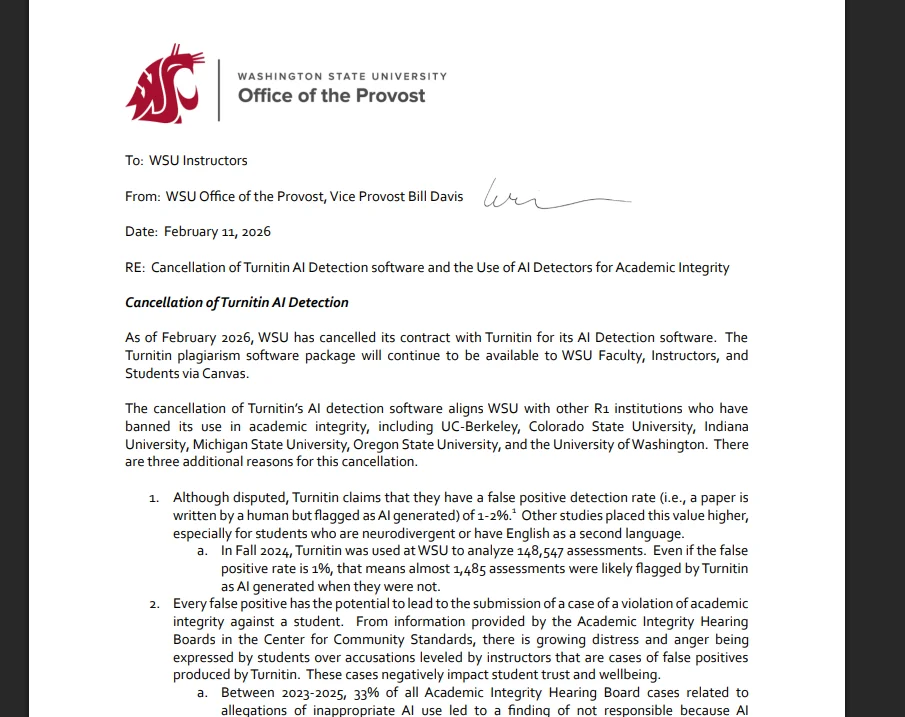
Washington State went further than anyone: it canceled its Turnitin AI contract outright in February 2026.
Institution-level "off" is not professor-level "off." If your school is on this list, your instructor may still see an AI score on your paper.
1. How to Read This List: Criteria, Sources, Verification Date
"Disabled" isn't one thing. We sort school decisions into three tiers:
Institution-level off — the university turned the AI writing feature off for all institutional accounts. Vanderbilt, Yale, and Michigan are in this tier.
Centralized off, instructor discretion — the school removed the default deployment and left the choice to individual faculty. Cornell sits here.
Contract terminated — the school ended its Turnitin AI agreement entirely. Washington State is the only one we can verify doing this.
Every row cites the school's own published policy page or an authoritative policy audit — mainly the Detection Drama review of the Top 50 (June 2026) — and every row was last verified on October 25, 2026. Rows are stale, not wrong, if a school changed its stance after that date — that's what the quarterly re-check is for.
We only list schools we can verify. Absence from this list never means it's safe to assume a school doesn't run the feature.
2. The A-Z List of Universities That Turned Off Turnitin AI
| School | Country | Disabled | Publicly stated reason | Verified |
|---|---|---|---|---|
| University at Buffalo | US | 2025 | Detector can't prove cheating; high error rates | Oct 25, 2026 |
| Cal Poly SLO | US | 2023–2026 | No institutional use of AI detection | Oct 25, 2026 |
| Cornell University | US | 2025–2026 | Ended centralized AI detection; instructor-level judgment | Oct 25, 2026 |
| Curtin University | Australia | Jan 2026 | "Building trust and clarity in contemporary academic culture" | Oct 25, 2026 |
| Georgetown University | US | 2025 | Accuracy and fairness concerns | Oct 25, 2026 |
| University of Iowa | US | 2025 | Fairness and reliability concerns | Oct 25, 2026 |
| Johns Hopkins University | US | 2024 | Accuracy issues | Oct 25, 2026 |
| University of Michigan | US | 2026 | AI detection "cannot provide definitive proof of cheating"; not recommended given error rates | Oct 25, 2026 |
| Northwestern University | US | 2025 | Accuracy and fairness concerns | Oct 25, 2026 |
| University of Pittsburgh | US | 2025 | Fairness and reliability concerns | Oct 25, 2026 |
| Stanford University | US | 2023–2026 | No institutional use of AI detection | Oct 25, 2026 |
| University of Queensland | Australia | 2025–2026 | Fairness concerns | Oct 25, 2026 |
| UCLA | US | 2025–2026 | Restricted detection-tool use; not recommended as evidence | Oct 25, 2026 |
| UC Berkeley | US | 2025–2026 | Restricted detection-tool use; not recommended as evidence | Oct 25, 2026 |
| University of Cape Town | South Africa | 2025–2026 | Fairness concerns | Oct 25, 2026 |
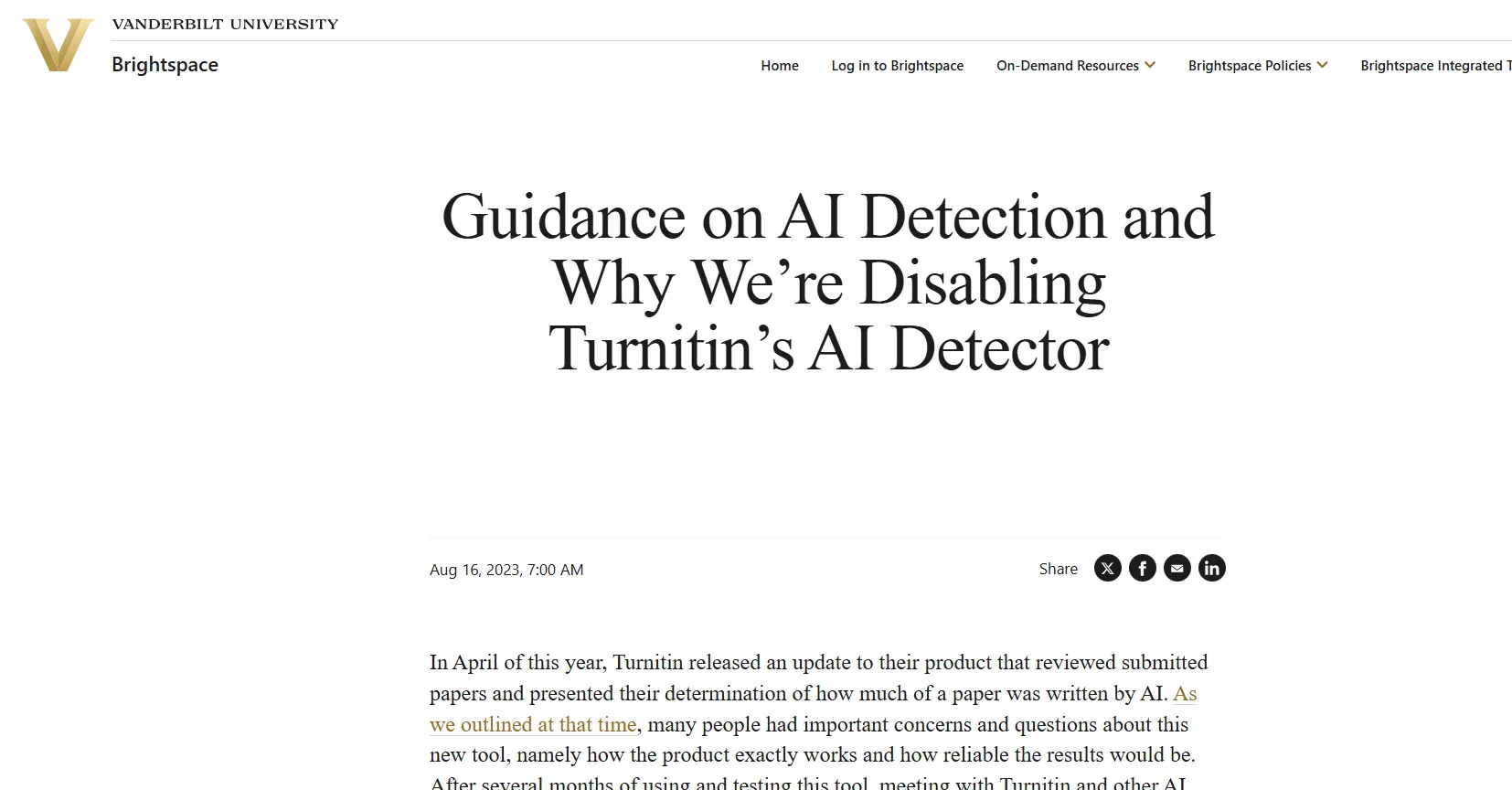
| Vanderbilt University | US | Aug 2023 | ~1% false-positive rate ≈ ~750 wrongly flagged papers per year | Oct 25, 2026 |
| Washington State University | US | Feb 2026 | Canceled the Turnitin AI contract outright | Oct 25, 2026 |
| University of Waterloo | Canada | 2025–2026 | No institutional use; instructor-level judgment | Oct 25, 2026 |
| Western University | Canada | 2025–2026 | No institutional use; instructor-level judgment | Oct 25, 2026 |
| Yale University | US | 2025 | Accuracy and fairness concerns | Oct 25, 2026 |
This is the verifiable core of the 61+ figure, weighted toward schools that publish policies. For the full US context, see our data page on Turnitin AI detection in US schools.
The Top 50 distribution, from the same June 2026 audit:
| Status among US Top 50 public universities | Count | Share |
|---|---|---|
| Explicitly kept AI detection on (Georgia Tech, UGA) | 2 | 4% |
| Disabled or not using | 35 | 70% |
| Undisclosed | 13 | 26% |
Source: Detection Drama review of official policy pages, June 2026; verified October 25, 2026.
3. Why Schools Are Quitting: The Numbers Behind the Decisions
The withdrawals aren't ideological. They're arithmetic.
Vanderbilt's math. Around a 1% document-level false-positive rate, applied to roughly 75,000 submissions a year, means about 750 papers wrongly flagged annually — each one a potential integrity case against an innocent student. Vanderbilt's 2023 statement that the false-positive risk was too high to use the tool in academic discipline set the template everyone else copied.
The ESL problem. A 2023 Stanford study (Liang & Zou) ran 91 genuine TOEFL essays — all written by human non-native speakers — through seven commercial detectors. 61.22% were flagged as AI by at least one tool; 19% by all seven. Native-speaker essays were misflagged at near zero. A detector that systematically distrusts international students is a liability, not a control.
The error bars. Turnitin itself discloses a ±15 percentage-point margin and hides exact scores under 20% behind an asterisk (*%) — our explainer on what the asterisk percentage means covers why that band is unreliable. A Washington Post field test at a real high school flagged roughly half of genuinely human essays.
Add the litigation pressure — six student lawsuits tracked in our lawsuit tracker — and the risk calculation flips for most general counsels before it flips for most professors.
4. The Bellwethers: Vanderbilt, Washington State, Michigan
Vanderbilt (August 2023) was the first and the one everyone cites. Disabling the AI detector in its Brightspace/Turnitin deployment, with the false-positive math in writing, gave other schools a defensible precedent.
Washington State (February 2026) went the furthest: not a settings change but a canceled contract. Turning off a feature is a policy decision; returning the product is a verdict.
Michigan (2026) supplied the sentence that ended the debate at peer institutions: AI detection "cannot provide definitive proof of cheating." A Big Ten school saying that in policy language moved the 2025–2026 wave more than any study did.
5. What "Disabled" Means for You as a Student
Three traps to avoid.
Trap 1: reading "off" as "gone." Most disabling policies leave instructor discretion intact. Your professor can often still enable the AI panel on their own account, and plenty do — especially in large-lecture courses where no one can verify writing in person.
Trap 2: assuming your school's status from this list. Only 2 of the Top 50 publish a clear "on," and 13 publish nothing. Outside the Top 50 adoption runs deeper: community college systems and online programs leaned into detection because they can't watch anyone write.
Trap 3: betting your grade on a policy you haven't read. The cheap hedge: see the same report your professor sees, before the deadline. InDetect routes your upload through authorized instructor accounts to the real Turnitin engine — we have no affiliation with Turnitin, nothing is stored in any repository (so your paper won't match itself at submission), and the paper and report are deleted within 24 hours. Reports take 5–30 minutes. US students fall inside the free-eligibility list: one free check for eligible new users (availability depends on your country), or Lite at $9/month for 2 checks — $4.50 per paper.
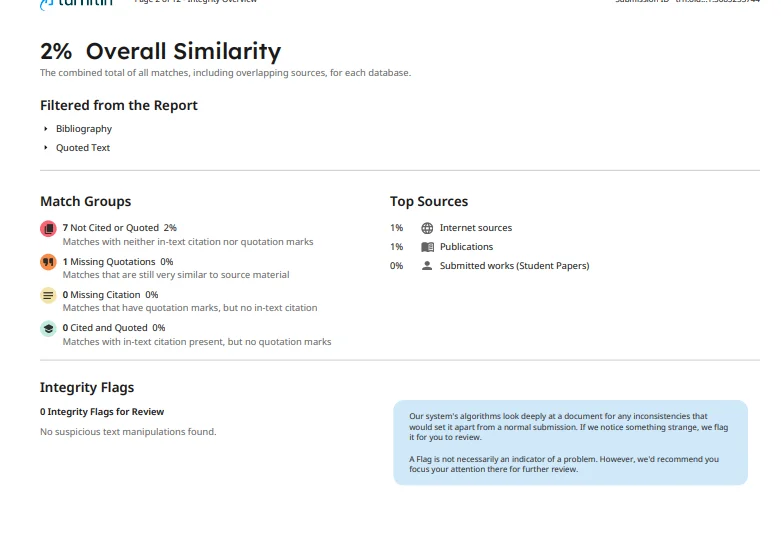
If you want the broader market view before choosing any tool, our comparison of Turnitin checker tools sorts the services by whether they run the real engine at all.
6. FAQ: Universities and Turnitin AI Detection
Which universities have disabled Turnitin AI detection? At least 61 across the US, Canada, Australia, and South Africa as of mid-2026, including Vanderbilt, Yale, Stanford, Cornell, Michigan, UCLA, UC Berkeley, Washington State, Waterloo, Western, Curtin, Queensland, and Cape Town. The A-Z table above lists the verifiable core with dates and reasons.
Does Yale use Turnitin AI detection? Yale disabled institutional AI detection in 2025, citing accuracy and fairness concerns. That's the university-level setting; individual instructors may still have discretion, so check your course syllabus.
Did Vanderbilt turn off Turnitin AI? Yes — first and most famously, in August 2023. Vanderbilt estimated that a ~1% false-positive rate would wrongly flag about 750 papers a year across its submissions and concluded the risk was too high for academic discipline.
If my university disabled it, can my professor still use Turnitin AI? Often, yes. Most "disabled" policies are institution-level and leave instructor discretion. A professor can run the AI panel on their own account unless the school terminated the contract outright — which only Washington State has verifiably done.
Why are universities turning off AI detection? Three reasons, in order: false-positive rates that generate wrongful accusations (Vanderbilt's ~750/year math), documented bias against ESL students (61.22% of real TOEFL essays flagged in the Stanford study), and legal exposure from student lawsuits over discipline based on a ±15-point score.
7. Bottom Line
The withdrawal wave is real — 61+ schools, 70% of the Top 50 — but it's partial, it's mostly institution-level, and it changes nothing about what shows up in your professor's report if they flip the switch anyway. Check your own school's policy page this week. Then, before your next submission, don't gamble on the policy: see the real number first. One free check for eligible new users (availability depends on your country), or Lite at $9/month for 2 checks.