UK University Turnitin AI Report: What Students Should Know

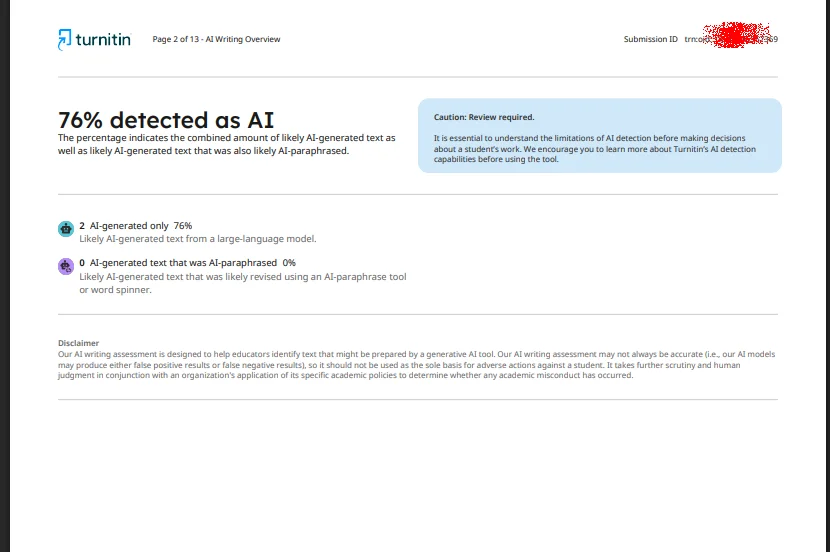
Short answer: Turnitin is close to universal at UK universities, but whether the AI writing detection module actually runs on your essay is set by your institution and often by your marker. Turnitin's Learning Integrity Insights Report (published July 2026, covering October 2025–April 2026 submissions) found that 9.8% of UK submissions came back with an AI score above 80% — roughly half the US figure of 19.4%. UK students are on the eligible-country list for one free check at InDetect, our service, so you can see the real Turnitin AI report before you submit, not after. Below: how UK policy works, what the numbers mean, and how to pre-check without a class ID.
A note on authorship. InDetect is ours — a third-party pre-submission checking service. We're not affiliated with Turnitin; we run papers through authorized instructor-level Turnitin accounts configured for zero repository storage. We have a commercial interest in you caring about your AI score, so weigh our framing accordingly; the data points below come from Turnitin's published report and university pages.
Key Takeaways
Turnitin is used by 16,000+ institutions worldwide and most UK universities have access — but the AI detection module is switched on or off at institution and instructor level.
Only 9.8% of UK submissions flagged an AI score above 80% in Turnitin's October 2025–April 2026 data, about half the US rate of 19.4%.
UK academic misconduct cases run on evidence plus a meeting and a panel, not on an AI score alone — and you can appeal.
Similarity and AI are two different numbers; scores between 1% and 19% may display as a *%, and Turnitin itself discloses a ±15-point error margin.
UK students are eligible for one free real-Turnitin check at InDetect before submitting, with the paper and report deleted within 24 hours.
1. Do UK Universities Use Turnitin AI Detection?
Almost every UK university you can name runs Turnitin in some form. The platform has been standard infrastructure in UK higher education for similarity checking for years, and Turnitin now reports more than 16,000 institutions using it worldwide.
The part students get wrong is what "uses Turnitin" means for AI detection. The AI writing score is a module, not a default. An institution decides whether it's available; an instructor often decides whether it runs on a specific assignment. Two students at the same university can submit to the same class of software and get completely different reports.
So the useful question isn't "does my university use Turnitin AI?" It's "is it switched on for my module?" Three ways to find out, in order of speed:
Check your module handbook or syllabus. UK universities increasingly publish AI-use statements per programme.
Look at the assignment page in your VLE — Moodle, Blackboard or Canvas. If an AI report is generated, it's configured there.
Email your marker. A one-line question, "will this be checked with Turnitin's AI writing detection?", is fair game before the deadline and awkward only in your head.
If your department is silent on AI, that silence isn't permission. Ask in writing, keep the reply, and treat the module as on until told otherwise.
2. UK University AI Policy Inventory
We checked five well-known institutions as of October 2026. Only two published a school-level statement we could verify; the honest row for the others is "not verified." Policy pages move — re-check before relying on any row here.
| Institution | Verified position (checked October 2026) |
|---|---|
| Oxford | Publishes an official policy page on AI use in assessed student work |
| Manchester | Academic integrity guidance references Turnitin and AI detection in marking |
| Cambridge | No school-wide AI-detection statement we could verify; settings vary by department |
| UCL | No school-wide AI-detection statement we could verify; check your programme handbook |
| Edinburgh | No school-wide AI-detection statement we could verify; check your division's guidance |
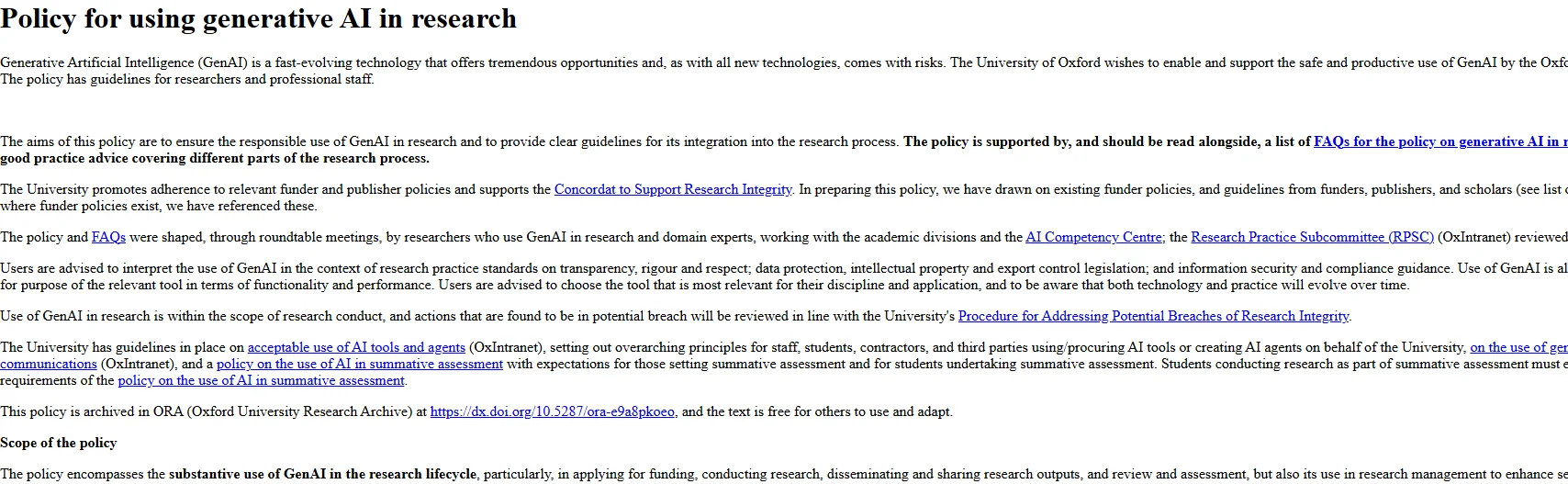
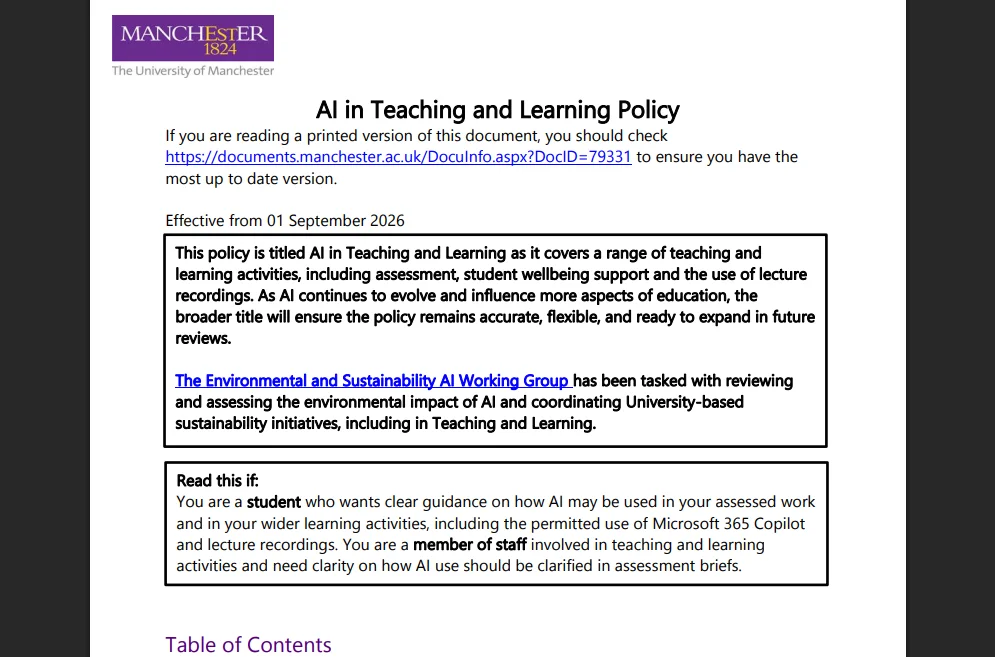
The pattern isn't one policy but a stack: institutional framework, departmental rule, marker's settings. Any listicle — including this table — is a starting point. Your module handbook is the answer.
2.1 The 9.8% Data Point: UK vs US AI Usage
Turnitin's Learning Integrity Insights Report, published in July 2026, covers submissions between October 2025 and April 2026 — more than 33 million in the US alone, with UK and Australian figures broken out for comparison. The headline for UK students: 9.8% of submissions returned an AI writing score above 80%. The US figure was 19.4%.
Read the metric carefully. It doesn't say 9.8% of UK essays are AI-written. It says that share of submissions came back in the detector's top band — and detectors put human writing in the top band too, which is the false-positive problem below.
What the comparison does suggest is that the UK picture looks different from the US: fewer flagged submissions, and a disciplinary process that leans on conversations rather than a single number. Our companion guide to Australia's Turnitin AI detection policy covers the same report's Australian figure (10.2%), which tracks the UK closely.
3. How UK Universities Handle AI Suspicions
A high AI score is not, by itself, a finding of misconduct at a UK university. The standard pattern is: the report becomes one piece of evidence; you're invited to a meeting — an informal resolution conversation or a formal interview, depending on the institution; and the case reaches a disciplinary or academic conduct panel only if it isn't resolved there. You can appeal a panel's outcome on defined grounds.
Two practical consequences. First, evidence of authorship — dated drafts, version history, notes — carries weight in a way a clean detector score never does. Second, the meeting is where an AI score gets tested: panels ask you to explain your writing, and honest work survives that question.
The contrast with the US is real. American campuses have seen a wave of student lawsuits over AI-detection accusations and suspensions, and several institutions have switched the module off entirely in response — we keep the confirmed cases in a running list of universities that disabled Turnitin AI detection. UK universities have responded more quietly, through conduct procedures rather than courtrooms — but the score can still be wrong, and you're the one who has to talk your way through it.
4. Reading Your Turnitin Report: Similarity vs AI Score
Your report contains two numbers that measure different things. Similarity is text-matching against Turnitin's databases — sources, internet, other student papers. The AI writing score is the detector's estimate of how much of your text looks model-generated. A paper can score 2% similarity and 40% AI, or 30% similarity and 0% AI. UK markers act on them differently, and conflating the two is how students panic over the wrong number.
Two mechanics trip up almost everyone:
The % display. When the AI score falls between 1% and 19%, Turnitin may show it as an asterisk instead of a number. We break down the full mechanism — and why a % isn't automatically good news — in our asterisk score explainer.
The ±15-point error margin. Turnitin's own documentation discloses that its AI scores can be off by roughly 15 percentage points. A 20% reading could be a 5% paper or a 35% paper. The number is a signal, not a verdict.
5. How UK Students Can Get a Real Turnitin AI Report Before Submitting
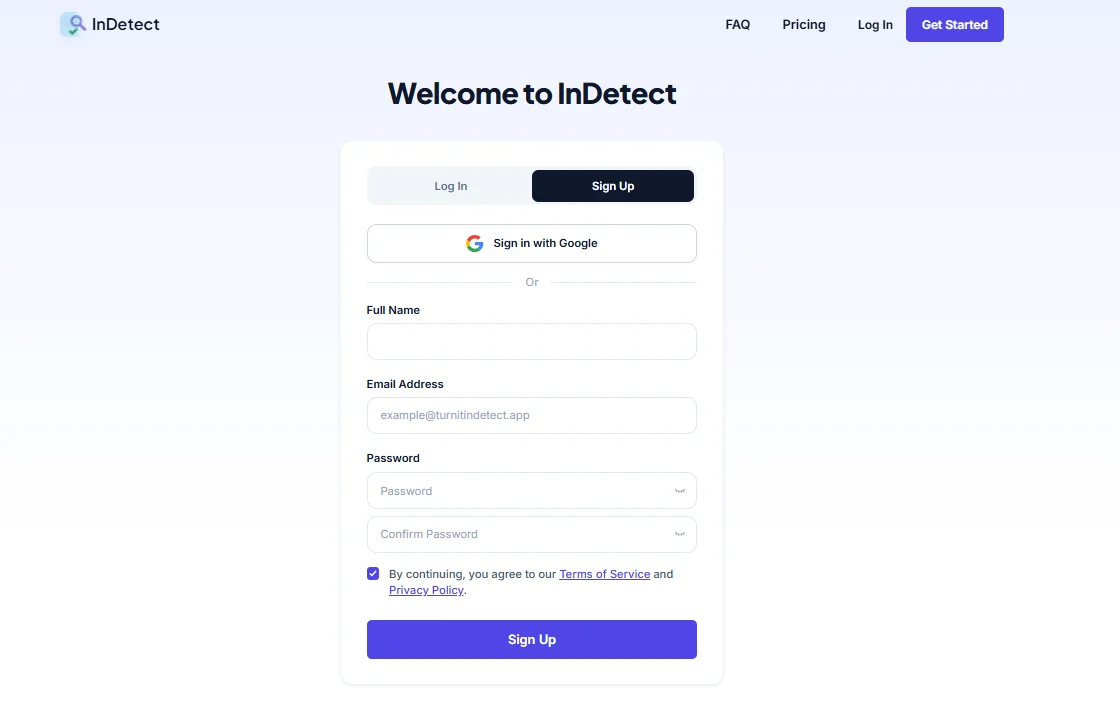
Turnitin doesn't sell students a preview. There's no personal account, no self-serve upload, and no way to run a report without a class ID on the official platform. The only pre-submission option that shows you the real engine's output is a third-party service that routes your paper through an authorized instructor account — which is what we built InDetect to do.
The UK is on the eligible-country list, so you get one free check for eligible new users (availability depends on your country at signup). The process: upload a PDF or DOCX; the paper runs through the real Turnitin engine in a zero-repository configuration, so it isn't stored in Turnitin's database and can't match itself when you submit later; your similarity + AI report comes back in 5–30 minutes; and both the paper and the report are deleted within 24 hours.
If you need more than one check, pricing is subscription-only: Lite is $9/month for 2 checks ($4.50 each — roughly £7 at recent exchange rates), Pro is $19/month for 6 ($3.17 each), and Ultra is $39/month for 20 ($1.95 each). Annual billing saves about 40%. Every check includes both the similarity and AI reports. There's no pay-more-for-a-deeper-scan tier, because it's the same report your marker sees.
What we don't do: no instant results promises, no humanizer upsells, no guarantee of a specific score. If a site sells you "lower your Turnitin AI score," close the tab.
6. FAQ: UK Students and Turnitin AI Reports
Do all UK universities use Turnitin AI detection? No. Most UK universities have Turnitin, but the AI writing module is configured at institution level and often at instructor level. Your module handbook or marker is the only reliable answer for your coursework.
What AI percentage is safe on a UK university essay? There's no official safe number. Turnitin discloses a ±15-point error margin, and scores between 1% and 19% may display as a *%. Treat anything above roughly 20% as worth understanding before you submit, and keep your drafts as evidence of authorship regardless.
Is there a free Turnitin AI check for UK students? UK students are eligible for one free check for eligible new users at InDetect, which runs the real Turnitin engine through an authorized instructor account. Free tools like GPTZero give you a different model's estimate, not your Turnitin score.
Can I run my paper through Turnitin before submitting without a class ID? Not through Turnitin itself — students have no self-serve access. A third-party pre-check service routed through instructor accounts is the practical route, and that's exactly what InDetect's free first check is for.
Will checking my paper add it to the Turnitin database? Not if the account runs in zero-repository mode, which is how InDetect is configured. Your paper isn't stored in Turnitin's database and won't match itself at submission; we also delete the paper and report within 24 hours.
7. Check Before You Submit
You don't need to fear a detector you can see coming. Read your module's AI policy, keep dated drafts, and if the score matters to your grade, look at the real report before the deadline rather than after. UK students are eligible for one free check at InDetect. If you're juggling multiple essays this term, Lite at $9/month covers two.