Turnitin Check for Masters Thesis Before Submission

Yes — you can see a real Turnitin report on your master's thesis or dissertation before your university's official check runs. Two rules make that safe. First, the preview must run with zero repository storage, or your paper will match itself at 100% when you submit for real. Second, a 150-page document should be checked chapter by chapter, not as one upload, because the AI panel and the similarity sources behave differently at length and you need to know which section is causing the number. This playbook covers the two numbers your committee sees, the repository trap, formulaic-section false flags, and what the whole thing costs.
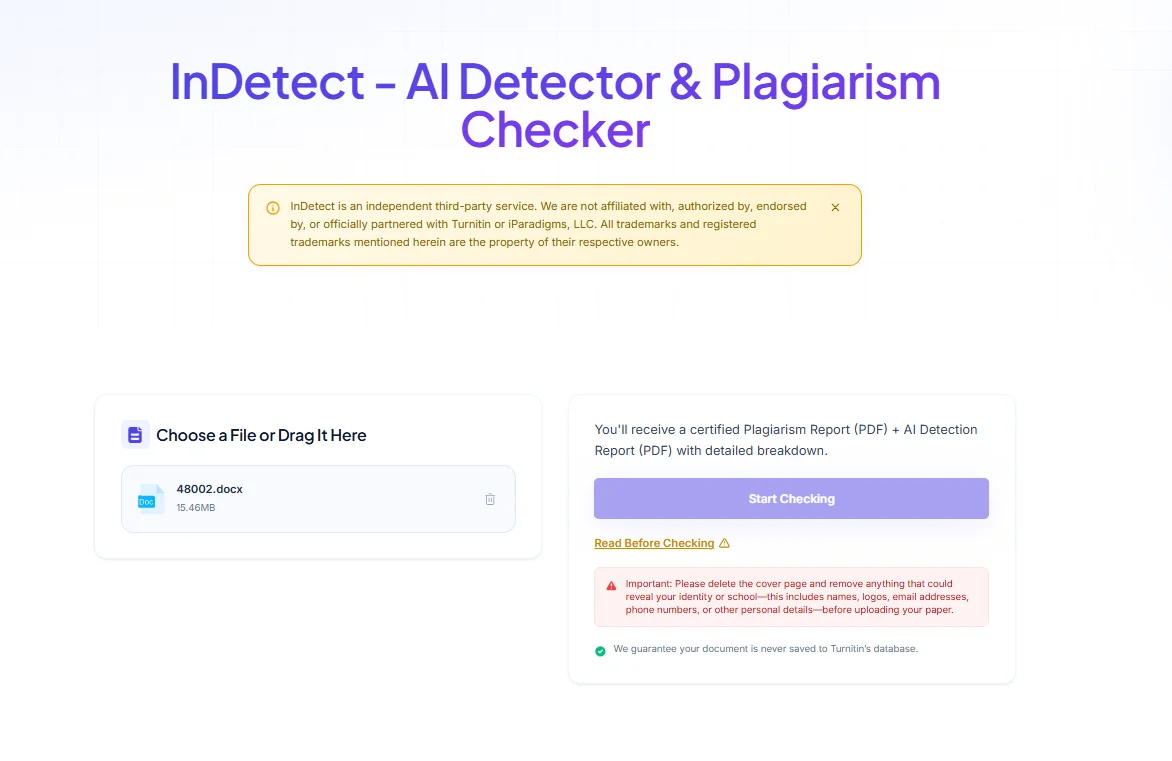
A note on authorship. Your advisor didn't write this — the team at InDetect did, a third-party service that runs pre-submission Turnitin checks through authorized instructor accounts. We are not a neutral party — section 5 recommends our own plans. The mechanics, thresholds, and error margins we cite come from Turnitin's own public documentation, and you can verify each claim before acting on it.
Key Takeaways
A thesis similarity score is not a coursework similarity score. Self-citation, direct quotes, reference lists, and instrument descriptions all push it higher — and committees read the source list, not the headline number.
Check chapter by chapter. Methods and discussion are the false-flag hotspots, and a whole-document report hides which section caused the score.
Never let a preview touch Turnitin's student repository. One stored check can blow up your official similarity report with a self-match.
Formulaic sections (IMRaD methods, regulatory boilerplate) get flagged by AI detectors even when you wrote them. Turnitin itself discloses a ±15-point error margin and roughly 4% sentence-level false positives.
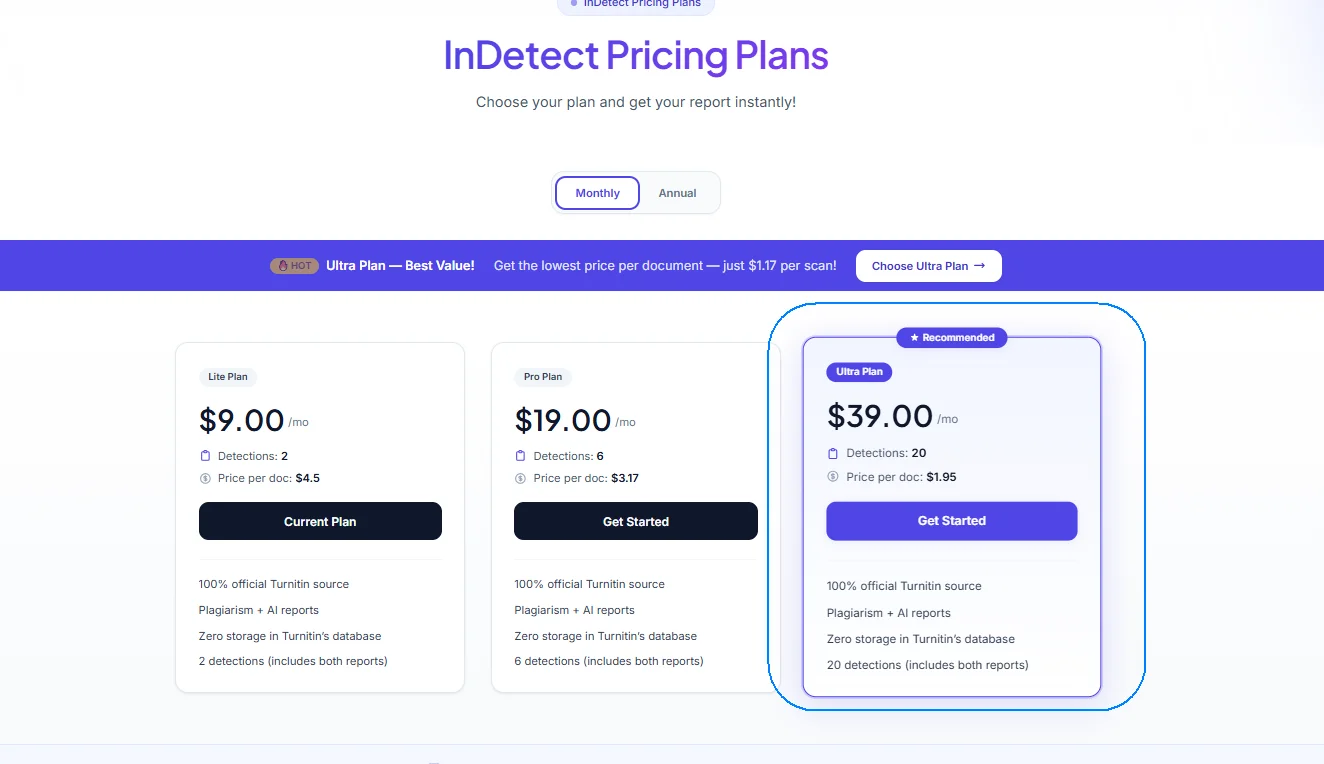
For multi-draft, multi-chapter work, Ultra at $39/month (20 checks, $1.95 each) or Ultra annual at $280 (240 checks, $1.17 each) is the cost floor. Every check includes both the similarity and AI reports.
1. The Two Numbers Your Committee Will See
Your university's submission runs produce two separate reports, and graduate students routinely conflate them.
The similarity report compares your text against Turnitin's databases: published literature, open web, and — critically — other students' stored submissions. A thesis almost always scores higher than your coursework did, for structural reasons: you quote your own published papers, you reproduce survey instruments and scale items verbatim, your reference list can run 15 pages, and your methods section paraphrases standard protocol language. None of that is plagiarism. A committee that reads your report looks at which sources matched, not the headline percentage.
The AI writing report is a different model answering a different question: how statistically machine-like does the text read? On long documents it returns a percentage for the whole submission plus flagged passages. Short sections can fall below the minimum word count and return no AI score at all.
Understanding both numbers — and what each one does and doesn't mean — is the actual skill. Our walkthrough of how to read a Turnitin report covers the interface in detail; the rest of this article assumes you've read it.
2. Chapter-by-Chapter or Whole Document? A Checking Strategy
Run the chapters, not the monolith.
Three reasons. First, diagnosis: a 22% similarity or 40% AI score on a bound thesis tells you nothing actionable. The same numbers attached to Chapter 3 (Methods) tell you exactly what to fix. Second, risk concentration: methods and discussion sections are where false flags cluster, because they're the most template-driven parts of any dissertation. Third, file limits: uploads cap at 20 MB, and a full thesis with embedded figures regularly exceeds that. A single-chapter DOCX never will.
One caveat on the AI panel: it needs a qualifying minimum of words to generate a score. A 6,000-word chapter is fine. A standalone 400-word chapter summary may return no AI reading — that's expected behavior, not an error.
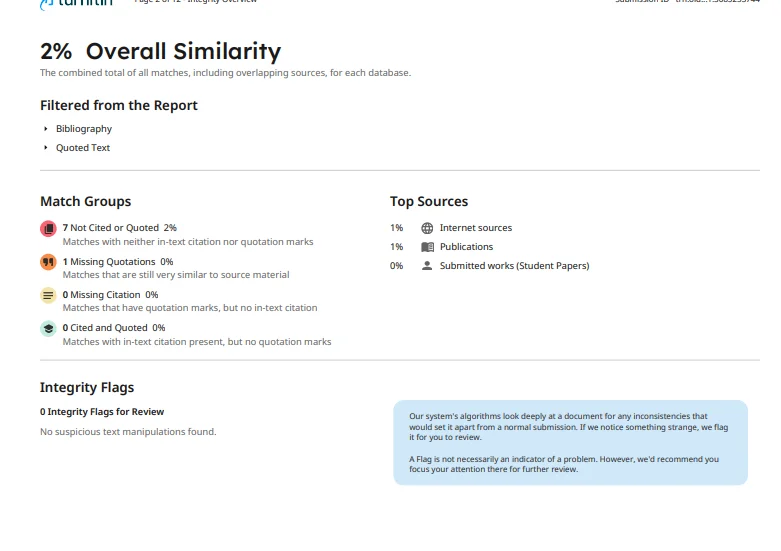
A sensible checking rhythm across a writing semester: each chapter once when the draft is complete, then a re-check after you fix flagged passages, then one final pass on the front matter plus abstract — the parts most likely to trip self-match against your published articles.
3. The Repository Trap: Why a Sloppy Check Can Sink Your Official Report
This is the section that saves careers.
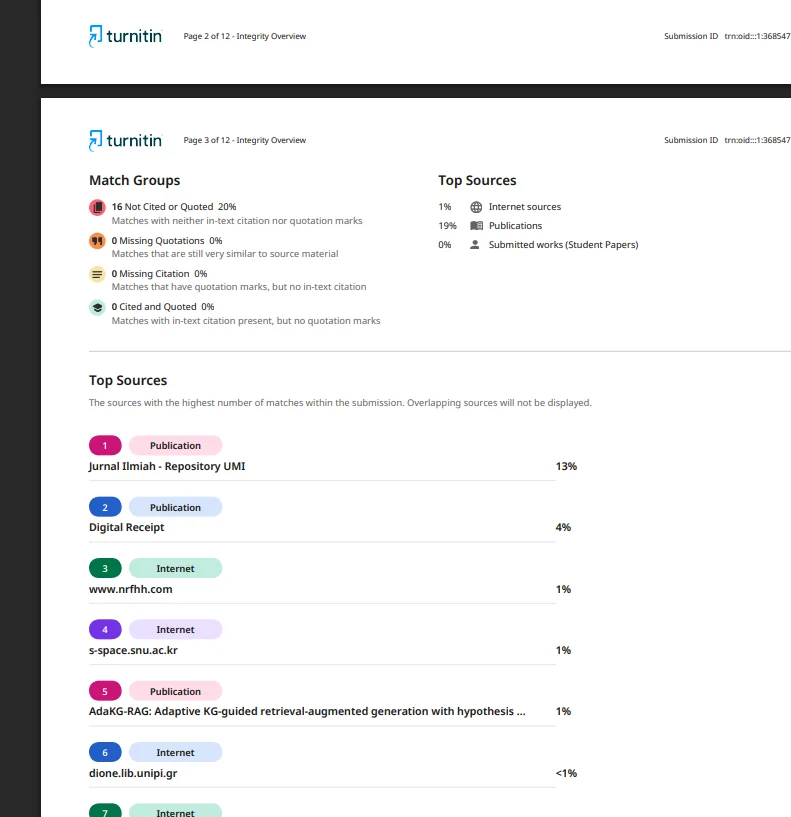
Turnitin's student paper repository is the database every future submission is checked against. If a preview of your thesis gets stored there — because a service ran it through a repository-enabled account, or because you used a free tool that quietly uploads to one — then your official submission matches your own paper. At or near 100%. The report reads like self-plagiarism or duplicate submission, and explaining "I checked it somewhere first" to an integrity committee is a conversation you do not want to have.
The rule is simple: a pre-submission check must run with zero repository storage, and the service should delete the paper and report within 24 hours. Ask any provider, in writing, before uploading. If the answer isn't on their site, that's your answer.
InDetect routes every check through instructor accounts configured for no repository storage, with 24-hour deletion of both file and report — that's the model we consider safe, and we're not the only ones who think the setting matters; our comparison of Turnitin checker tools scores every service we tested on exactly this.
4. Handling High AI Scores on Formulaic Sections
You wrote the methods section yourself. It still comes back 60% AI.
This is the known failure mode of statistical detectors on academic boilerplate. IMRaD methods prose, IRB protocol language, regulatory and clinical templates — all of it is deliberately uniform, and uniformity is precisely the signal these models read as machine-generated. Nursing care plans hit the same wall from a different direction; our nursing school guide has the detail. Turnitin's own disclosures put the error margin around ±15 percentage points on the overall score, with roughly 4% of sentences misclassified. That margin applies equally to a doctoral candidate's methods chapter and a 10th grader's five-paragraph essay — the underlying failure mode is the same, which we detail in our high school AP guide.
What actually helps: add study-specific detail where the template allows it (your sample, your site, your deviations), vary sentence openings in boilerplate passages, and rewrite the flagged sentences in your own rhythm rather than paraphrasing with a tool. Then re-check the chapter and confirm the number moved. Don't chase zero — chase "explainable."
5. Cost Strategy for Multi-Chapter Drafts
Do the usage math before you pick a plan.
A typical master's thesis is 5 chapters. Check each once at draft completion, re-check two of them after revisions, plus one abstract pass: about 8 checks. Add a dissertation under a committee that iterates, and you're at 12–15 checks across a semester.
| Plan | Price | Checks | Per check | Fit |
|---|---|---|---|---|
| Lite | $9/month | 2 | $4.50 | One chapter, one deadline |
| Pro | $19/month | 6 | $3.17 | A single-chapter graduation requirement |
| Ultra | $39/month | 20 | $1.95 | Full multi-chapter drafting cycle |
| Ultra annual | $280/year | 240 | $1.17 | Year-long thesis + journal submissions |
Ultra monthly is the default for graduate students; the annual plan at $1.17 per check (roughly 40% below monthly rates) makes sense once you're also checking manuscripts and grant writing. Every check includes both the similarity and AI reports — you're never buying the "other" number separately. Reports take 5–30 minutes, so build the wait into your editing loop, not your submission evening.
New users get one free check for eligible countries (availability depends on your country — the U.S., Canada, the U.K., Ireland, most of the EU, Australia, New Zealand, Japan, South Korea, and several others qualify; India, the Philippines, and Pakistan are paid-only). Eligibility is determined at checkout; go by what the signup page shows you.
6. FAQ: Turnitin Checks for Theses and Dissertations
Can I check my dissertation on Turnitin before submitting?
Yes — through a third-party service that routes your paper through an authorized instructor account, like InDetect. You get the same similarity and AI reports your university will generate, before your committee does. Reports take 5–30 minutes.
Will checking my thesis first make it match itself in the official report?
Only if the check stores your paper in Turnitin's student repository. Use a service with zero repository storage and 24-hour deletion, and there is nothing left behind to match. This is the single most important setting to verify before uploading anywhere.
Does Turnitin AI detection work on a single dissertation chapter?
Yes, as long as the chapter exceeds Turnitin's minimum word requirement for the AI panel. Checking chapter by chapter is actually the recommended strategy — it localizes the score and stays under the 20 MB upload limit.
What similarity score is acceptable for a master's thesis?
There is no universal threshold, and theses legitimately run higher than coursework because of references, quotations, and self-citation. Committees look at which sources match and whether overlap is attributed. Focus on eliminating unexplained matches, not on hitting a number.
What file size can I upload for a thesis check?
20 MB per document, in PDF or DOCX. A full bound thesis with figures often exceeds that — split it by chapter.
7. Check Like a Researcher, Not a Gambler
You've spent years documenting everything else about your research. Your Turnitin report is one more thing worth measuring before it's final.
The sequence: chapter-by-chapter checks, zero-repository route, fix the formulaic sections, keep the reports as evidence of your process. Eligible new users can claim one free check (availability depends on your country); for a full drafting cycle, Ultra at $39/month covers 20 checks at $1.95 each, and the $280 annual plan drops that to $1.17. Submit knowing both numbers.