Will a Third-Party Turnitin Check Cause Self-Plagiarism?

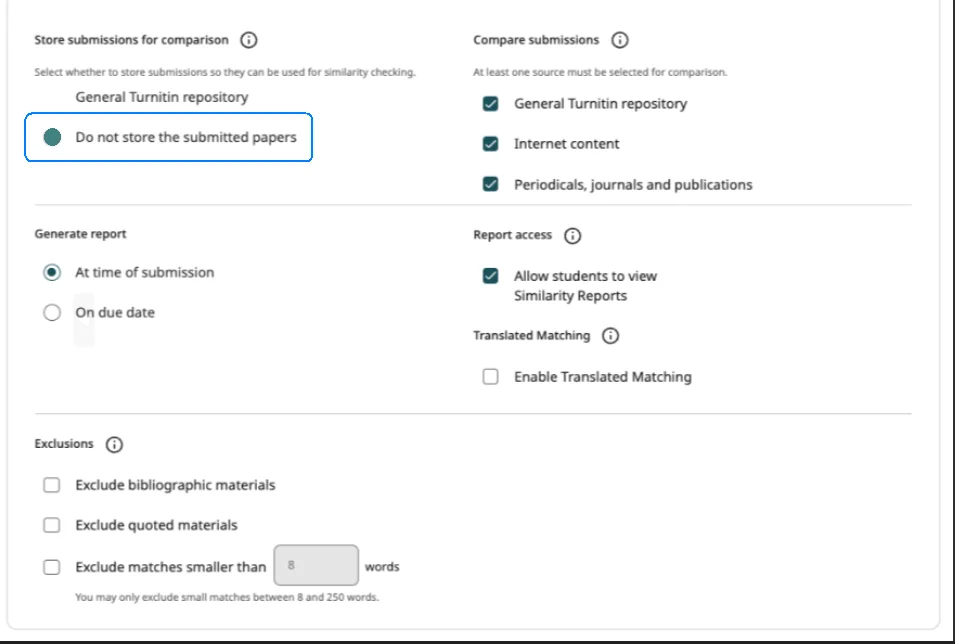
No — provided the checker runs your paper through a Turnitin account configured not to store student papers. The risk is real, though: if your draft lands in Turnitin's student paper repository, your official submission matches your own archived paper at nearly 100%, and you're suddenly defending a self-plagiarism flag you created yourself. A zero-repository service changes nothing: the paper is processed, the report is returned, nothing is archived, and your real submission sees no trace of the preview. The repository setting is one checkbox, and it's the first question to ask any checker before you upload.
A note on authorship. We run InDetect, a third-party pre-submission checker with no official connection to Turnitin. Every instructor account in our pipeline is configured for zero repository storage, and papers and reports are deleted within 24 hours. We have an obvious interest in saying pre-checking is safe — so this article explains the mechanism itself, so you can interrogate any service the same way.
Key Takeaways
A pre-submission check causes self-plagiarism only if the checker's account stores papers in the student repository.
Repository storage is an instructor-side setting on every Turnitin assignment. "No repository" means the paper is processed and never archived.
A stored paper matches your future submission at nearly 100%, and you cannot un-store it.
Verifiable markers of a safe service: a published zero-repo policy, a 24-hour deletion window, and a working delete button.
Turnitin reports carry no history of who checked a paper — but if your school bans third-party checkers, the exposure is academic policy, not technology.
1. How Turnitin's Student Paper Repository Actually Works
Every Similarity Report checks your text against three source families: live web pages, licensed publications, and stored student papers. The third one is the repository — a growing database of submissions from every institution on Turnitin's network.
Whether a submission enters that database depends on a setting chosen when the assignment is created. Store-on means every paper submitted becomes a match source for every future submission, forever. That's what makes double submissions dangerous: the second matches the first. It's also what makes a careless third-party check dangerous: your preview becomes the archived copy your real submission gets accused of copying.
2. The One Setting That Decides Everything: Repository On vs Off
When an instructor creates an assignment, Turnitin asks whether submissions go to the Student Paper Repository. In the interface, it's a choice to submit or not submit papers to the repository. Choose no-repository and the pipeline changes completely: the engine still runs, the report still generates, similarity and AI flags still come back — but the document is not filed anywhere. It's checked, not collected.
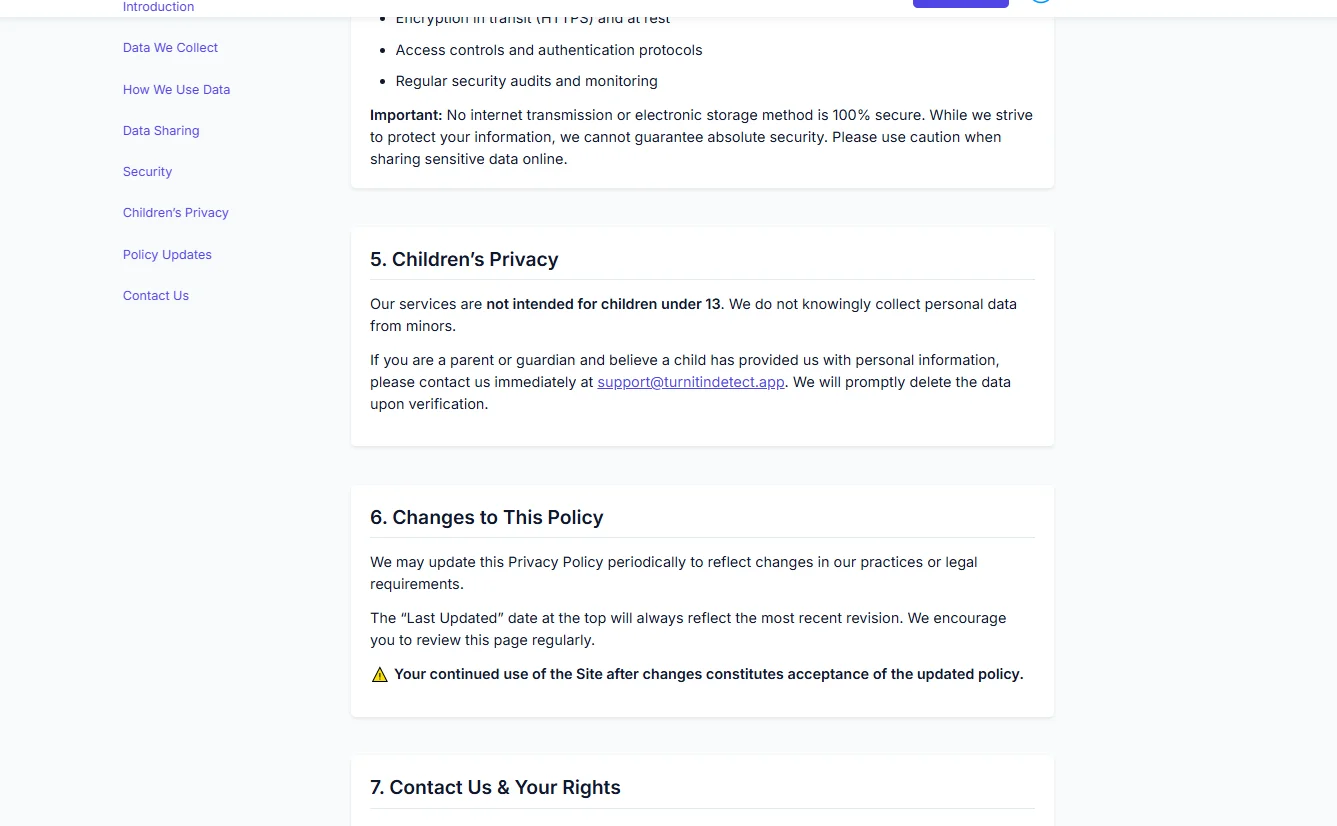
This toggle is the first indicator of whether a third-party checker is safe. A legitimate pre-submission service creates every assignment with storage off, by design, on every account. If a service can't answer "do you store to the student repository?" in one clear sentence, that answer is the answer.
3. Will a Third-Party Check Make Your Paper Match Itself at 100%?
Two scenarios, two completely different outcomes.
The storing service. You upload your draft to an account whose assignments store submissions. Your paper enters the repository. Days later you submit the same paper through your university. The report comes back with similarity near 100%, matched against a student paper — yours. Now you explain why your original work matches an archived submission from a school you've never attended — and the stored copy can't be pulled.
The zero-repository service. Your paper is routed through an account with storage disabled. The engine processes it, the report returns, the file is deleted from the service's systems within 24 hours. The repository never sees it. Your official submission matches only external sources.
The difference between a scare and a non-event is one checkbox on an account you'll never see.
4. How a Zero-Repository Pipeline Is Built (and Why You Can't Audit It Yourself)
Here's the mechanism at InDetect, representative of a careful real-engine service. Every authorized instructor account used for student checks is created with repository storage off — not per-assignment discretion, but as a standing configuration nobody on the user side can flip. Papers are routed, processed, reported, and then deleted from every stage of the pipeline within 24 hours. The text isn't used to train anything, and there's no humanizer to upsell you, because a service that profits from flagging your paper has a reason to flag it.
Be honest about the limits: you can't audit this. You'll never log into our instructor accounts to check the settings. What you can demand is two things — a public, specific commitment, not "we care about privacy" boilerplate, and verifiable traces you can test yourself.
Your first check at a zero-repo service costs nothing if you're an eligible new user (availability depends on your country), so you can watch what happens to your own file before paying anything.
4.1 The 24-Hour Deletion Policy: Promise vs Mechanism
A deletion policy is words; a deletion mechanism is software. The difference shows up in the dashboard. Look for:
A "Delete now" button that removes your paper and report on demand, not "within X business days via support ticket."
A visible deleted state — the entry disappears or is marked deleted, with a timestamp.
A policy that says what's covered: paper text, generated report, email attachments, backups, and an explicit "not used for training" line.
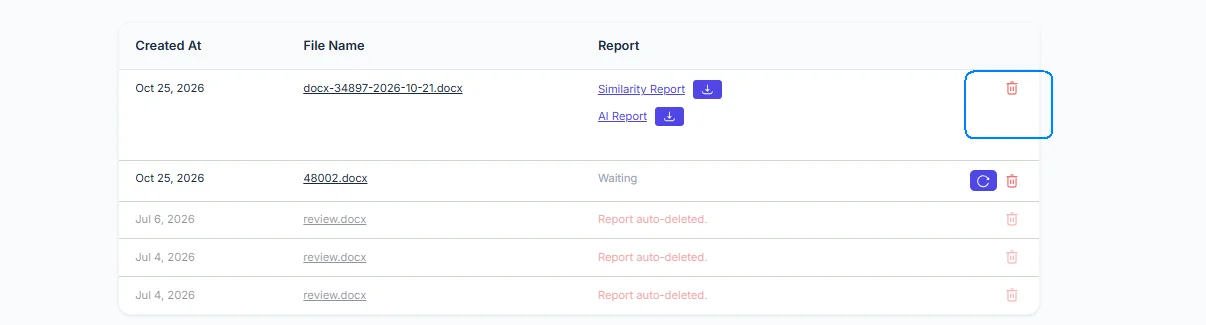
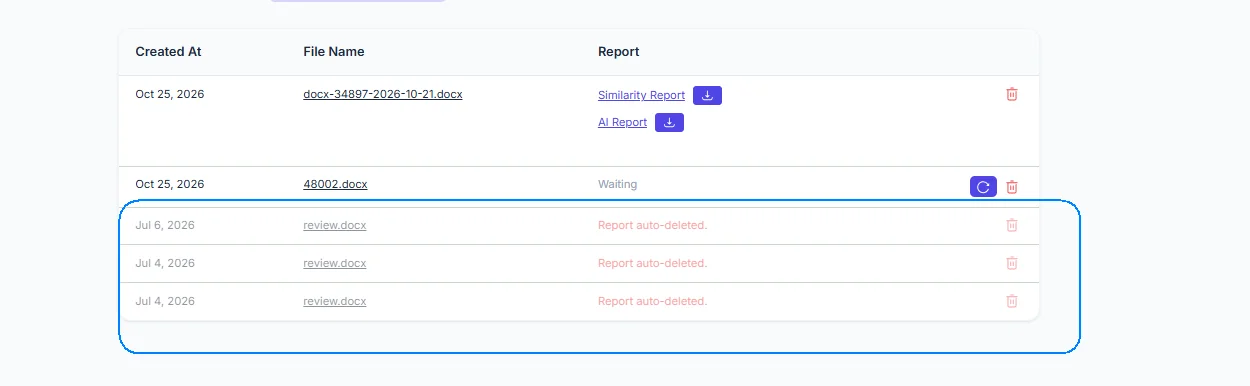
If a service shows you the button and the after-state, the policy is at least testable. If it only shows you the paragraph, you're trusting an audit you can't perform.
5. Do Turnitin Checkers Use My Paper as Training Data?
For free services, your paper usually is the product. Detector companies need fresh labeled academic text; the arms race with humanizer tools runs on the drafts people upload for "free" checks. A permissive clause — "we may use aggregated data to improve our services" — is the legal plumbing for that. We map that economy in detail in how free checkers monetize your paper.
Do the math on "free unlimited." Every real-engine run costs the service Turnitin capacity through a real instructor account. A checker that gives unlimited free checks either isn't running the real engine, or is paying for it with your text. Real-engine services fund their free first check with subscriptions and restrict it by country, because the giveaway has a hard cost.
6. Can Turnitin Tell You Used a Third-Party Checker?
Technically, no. The report contains no history field — nothing shows who ran a check before your class submission. Under zero-repository configuration, the preview leaves no archived copy. Turnitin documents the report as a snapshot of matches and flags, not a log of prior checks.
The real exposure is policy, not technology. Some schools explicitly prohibit uploading coursework to third-party checker sites. If your professor finds out you used one, the argument shifts from your AI percentage to the unauthorized upload. Read your syllabus and your school's AI policy first. Our comparison of nine checker tools covers how services differ on these questions.
7. Red Flags: How to Spot a Checker That Archives Your Paper
Walk away from a service that shows any of these:
No deletion policy at all, or one buried in 4,000 words of boilerplate.
No delete button and no way to request removal of your paper.
Unlimited free checks — the price is below the real cost of the engine, so your text is paying the difference.
Your kind of paper shown as a public "example report" without clear consent from its author.
Evasion on the repository question. Ask "do submissions store to the student paper repository?" A real zero-repo service answers in one sentence. A hedge means maybe.
Compare tools on these five points, not their landing pages. If timing is your problem rather than storage — deadline tonight — our fast Turnitin check countdown plan pairs with the pre-submission guide.
FAQ: Third-Party Checks, the Repository, and Your Paper
Will a third party Turnitin check cause self plagiarism? Only if the checker stores your paper in Turnitin's student repository. A service running zero-repository instructor accounts never archives your paper, so your official submission can't match itself. A storing service archives it, and the self-match at nearly 100% is effectively permanent.
Is it safe to upload my paper to a Turnitin checker? Safe on the repository question if the account is configured not to store — that's the first thing to verify in writing. Then check the deletion policy, whether a user-triggered delete exists, and the training-data clause in the terms. A service that clears all four is as safe as pre-checking gets.
Do Turnitin checkers store papers in the student repository? It depends entirely on the instructor-side setting of the account processing your paper. Legitimate pre-submission services configure no-storage on every account. Free lookalikes may do other things with your text entirely — retention, training data, or resale — which is a separate risk from the repository.
Can Turnitin tell if I used a third party checker before submitting? The report itself carries no history of prior checks, and a zero-repository preview leaves no archived trace. The risk isn't technical detection — it's your school's policy. If your institution prohibits third-party checkers, use is a conduct issue regardless of what Turnitin can see.
What does a 24 hour deletion policy actually cover? It should cover your paper text and the generated report across the service's systems, with a user-triggerable delete and an explicit no-training clause. Check whether backups are excluded and whether "aggregated data" language lets them keep your text in another form.
Ask the Checkbox Question First
The whole self-plagiarism fear comes down to one instructor-side setting: repository on or off. Off means a preview is a measurement with no memory — processed, reported, deleted within 24 hours, nothing archived. On means your draft becomes a permanent match source against your own future work. Before you upload anywhere, ask the question in writing and watch how fast they answer. If you want a zero-repo preview, eligible new users get one free check (availability depends on your country), and Lite is $9/month for 2 checks — reports take 5-30 minutes, and your paper is gone within a day.