Free Turnitin AI Detection: The Truth, the Risks, and the One Real Option

Direct answer — there is no such thing as a "free Turnitin AI check" sold by Turnitin. There never has been. The phrase, as it exists on Google, points to a marketplace of third-party services that promise the official report for $0, and almost none of them run the real Turnitin engine. This article explains what they actually sell, what they actually take from you, and the one place where a real Turnitin AI report can still be obtained for free — under a strict, intentional set of limits.
A note on authorship. This article is published by the team behind turnitindetect.app, a service that connects students to authorized instructor-level Turnitin accounts so they can preview the real AI writing report their professor will see. Where this article compares scores across free tools, the "ground truth" column is generated by the actual Turnitin engine running through our pipeline. We are not a neutral observer of this market. We are one of the few actors in it doing what the others claim to do. We say this upfront so you can weigh everything that follows accordingly.
Key Takeaways
Turnitin has never sold a free, student-facing AI detector. Every "free Turnitin AI check" is a third-party service.
The market splits into three categories: simulators that predict a Turnitin score, paid services with a one-shot free hook, and gray-area services that run real Turnitin through instructor accounts. Only the third category is the real thing.
"Free" almost always means your paper becomes the product: training data for a detector, an upsell funnel for a humanizer, or a lead for a paid plan.
A low AI score on a free tool is not a low score on Turnitin — only the engine your professor runs is a true measurement.
turnitindetect.app runs the real Turnitin engine and offers a genuine free check — under strict country eligibility, anti-duplicate controls, and anti-abuse enforcement, because the resource is intentionally scarce.
1. What Does "Free Turnitin AI Detection" Actually Mean in the Market?
If you have ever typed "free Turnitin AI detection" into Google, you have seen the results. A wall of websites promising to check your paper, for free, using the same AI writing detection your school uses. The results look interchangeable. The branding is intentionally similar. The pricing page, when you finally find it, almost always leads to a paid tier.
The problem is that the phrase itself is a marketing construction. Turnitin has never released a public, free, student-facing version of its AI writing detector. Turnitin's own help center confirms this: the AI writing feature exists only inside the institutional Similarity Report workflow, run by instructors at subscribing universities, against papers students have already submitted. The report is not designed to be a preview. It is designed to be a verdict, delivered after the deadline.
So when you search for "free Turnitin AI detection," you are not finding Turnitin. You are finding the third-party services that have built businesses around the gap between what students want and what Turnitin sells.
1.1 The Three Types of Free Turnitin AI Detection
Strip away the marketing and the search results collapse into three distinct kinds of service. Knowing which one you are looking at changes everything about how you should use it.
Category A — Simulators and Predictors
These services do not run Turnitin at all. They run their own AI detection model (often a fine-tuned transformer, sometimes a perplexity/burstiness calculator) and predict what they think a Turnitin score would be. The most prominent example is the free checker at aiturnitinchecker.com, which uses Pangram — a model that was peer-reviewed at ICLR 2026 and claims ~99% accuracy with about a 1-in-200 false positive rate. Pangram is not Turnitin. It is a genuinely good AI detector in its own right. But the number it gives you is the number Pangram thinks your paper deserves, not the number Turnitin would assign.
These services are the most honest about what they do. They say "estimate" or "predict" right on the landing page. The risk is that students skim past the word "estimate" and treat the output as authoritative.
How to spot a simulator in 30 seconds. The single most reliable tell is the input method. Simulators ask you to paste text into a box and return an answer in seconds. Real Turnitin runs as a document check, not a paste-box check: it extracts text from your PDF or DOCX, routes it to an instructor account, and queues it for several minutes. So if a "free Turnitin AI check" only accepts pasted text and flashes a result in under five seconds, it is, by construction, a simulator. Four more tells, in order of reliability:
Paste box, no upload. A real-engine service accepts PDF/DOCX uploads up to 20 MB. If the only input is a text area, the service cannot be running the Turnitin engine.
Instant score, no report. Real Turnitin returns a report — sentence-level highlights, per-paragraph breakdown — not a single percentage. A bare percentage with no document attached is a prediction.
No verification required. Simulators take any text from anyone, instantly, because running their model costs almost nothing. Real-engine services require an account, email or phone verification, and queue time, because every check consumes paid Turnitin capacity.
The word "predict." If the page says "predict your Turnitin score," "estimate," or "what Turnitin would see," believe the wording. It is admitting it is not Turnitin.
Category B — Free-Tier Hooks
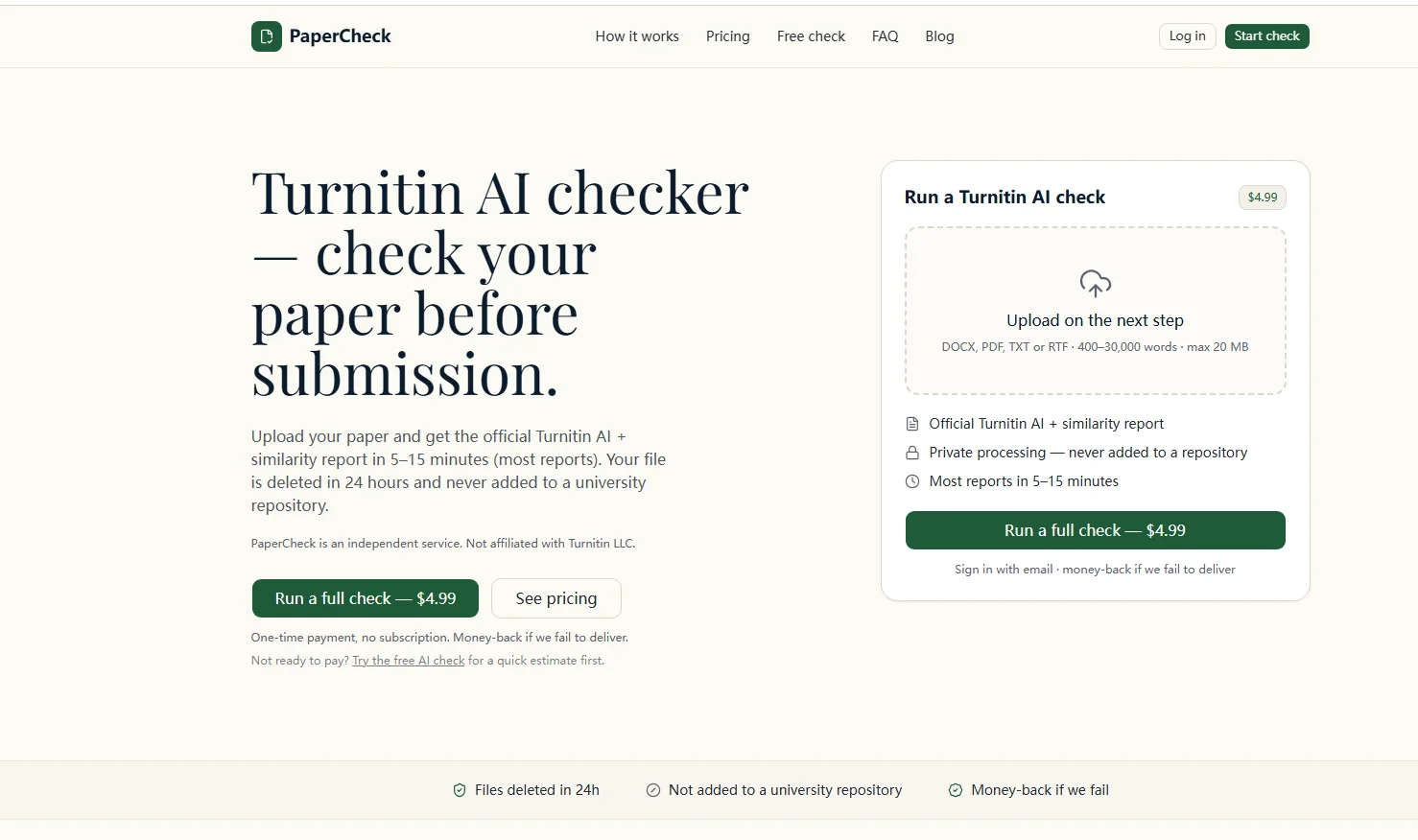
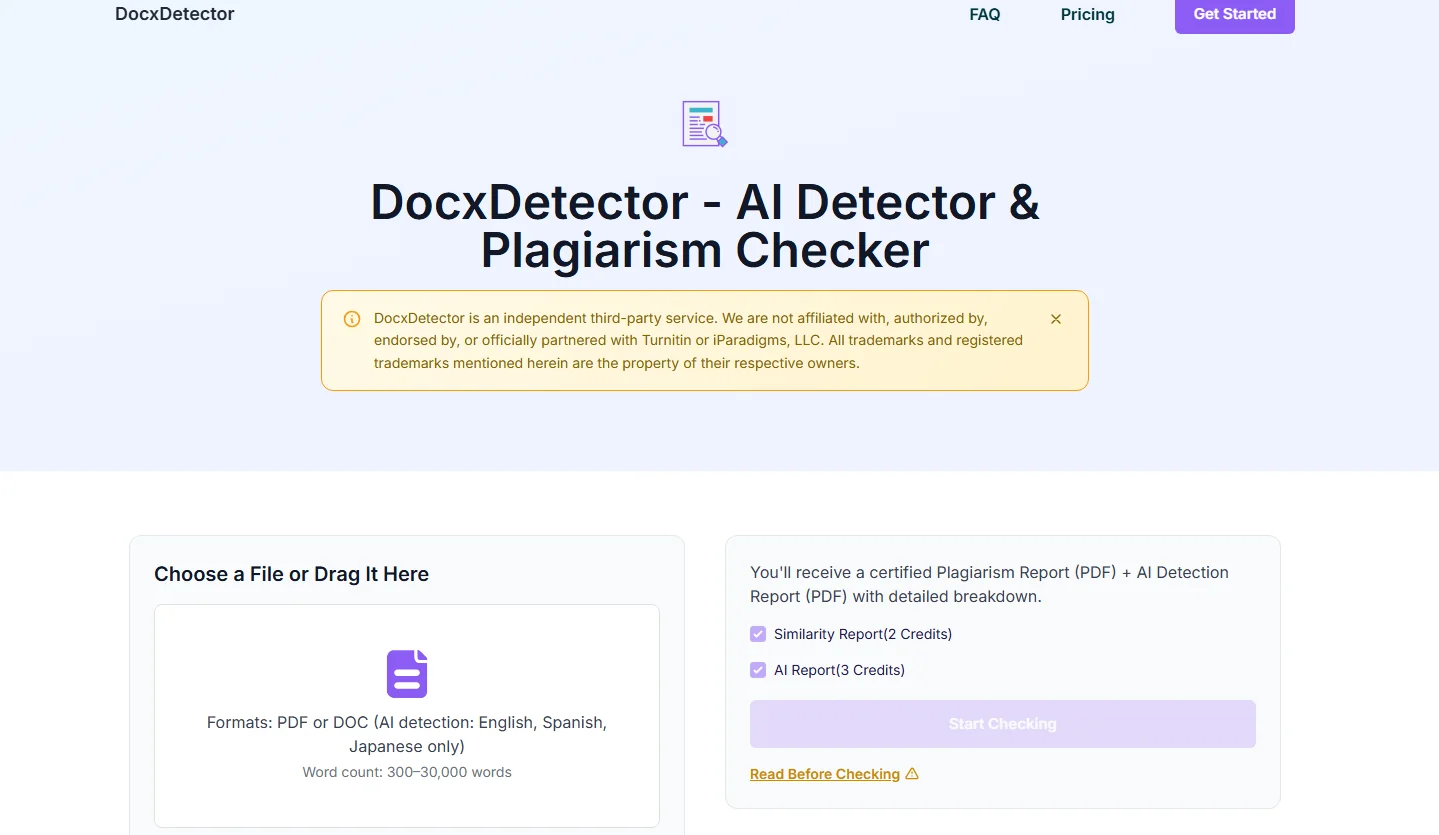
These services do run the real Turnitin engine (or claim to), but the "free" check is a one-time credit designed to convert you into a paid customer. DocxDetector[https://www.docxturnitin.com/] operates this way: one free check per new user, with paid tiers starting at $9 for a single additional report. T-detector, TurnDetect v2.0, and T-checker all use variations of this model. The free check is real. The upsell is the point.
The risk here is more subtle. A single free check teaches you nothing about consistency. If you get 18% on a draft and the real Turnitin score on submission is 42%, you have no way to calibrate. The free check feels like a gift; it is actually a sampler of an experience you cannot reproduce without paying.
Category C — Gray-Area Real-Turnitin Services
A smaller group does not bother with the pretense. They use instructor-level Turnitin accounts (legitimately obtained through partnerships with teachers or, in some cases, less legitimately obtained) to run your paper against the real Turnitin engine and deliver the actual report. turnitindetect.app falls into this category, as do a handful of competing services. The technology is real. The ToS position is murky. The risk to students, if the accounts are ever flagged by Turnitin, is real too.
This is also the only category that can legitimately claim to give you "the report your professor will see." The first two categories cannot, by definition.
1.2 Why Turnitin Will Never Offer a Free Student Version
It is worth being clear about why this gap exists in the first place, because it explains the entire market.
Turnitin's AI detection was built as a post-submission integrity check. It runs in the instructor's workflow, on already-submitted work, as part of an institutional contract. The system was never designed to be a pre-submission preview tool. Making it one would require:
A student-facing UI (which Turnitin has never built)
A pricing model for individuals (which conflicts with the institutional licensing model that funds the company)
A way to prevent students from gaming the detector by seeing their own scores (which would defeat the integrity use case)
A new set of data-handling rules for papers that are not yet submitted (which would require a separate consent framework)
None of these are technically hard. All of them are commercially unattractive. Turnitin's revenue is in institutional licenses, priced per student per year, sold to universities. Building a $0 student tier would cannibalize the institutional product without adding meaningful new revenue. So the company does not build one. The search demand does not go away. Third parties fill the vacuum.
1.3 Free Almost Never Means Turnitin
The single most important fact in this entire article is the one almost no "free Turnitin AI detector" website will tell you clearly: the overwhelming majority of services that rank for "free Turnitin AI detection" do not run the Turnitin engine at all. They run something else — often a generic AI classifier, sometimes a model the service built itself — and they show you a percentage that looks like a Turnitin percentage because the markup mimics Turnitin's report.
This is not necessarily dishonest. A good independent detector can give you a useful signal. But it is not Turnitin, and the score is not comparable. Treating one as the other is the single most common mistake students make with these tools.
The stakes are higher than a wrong number. These detectors disproportionately — a problem we break down in detail in our explainer on how Turnitin AI detection actually works and who gets falsely accused.
2. The Hidden Cost: How Free Services Monetize Your Paper
If a service gives you something for free, you are not the customer. You are the input. The "free" tier of the AI detection market is not subsidized by investors or by goodwill. It is funded by the value of what you upload. Understanding that value chain is the only way to use these tools safely.
2.1 Your Paper Is Their Training Data
The most common monetization model is the quietest. You upload a draft. The service runs it through a detector and shows you a score. Behind the scenes, depending on the privacy policy and the jurisdiction, the text may be retained, added to a corpus, and used to retrain or fine-tune the next version of the detector.
For an established service with a published privacy policy and a 24-hour deletion guarantee, the risk is bounded. For a free-tier service with a vague "we may use aggregated data to improve our services" clause buried in the terms, the risk is that your unpublished thesis, your novel, your research direction, or your company's confidential report becomes a labeled training example for a model you will never see again.
This is not hypothetical. The AI detection market is, in 2026, in the middle of an arms race with the humanization market. Detectors need fresh labeled data. Humanizers need to know what the latest detector flags. Both sides want your text. Both sides can get it, with a permissive ToS and a free upload.
2.2 The Detect → Humanize → Charge Funnel
A second, more visible monetization path is the upsell. The free detector flags 76% of your paper as AI. A banner on the result page says, "Want to bring that down? Try our humanizer." You click. You land on a paid tool — typically $10 to $30 per document — that rewrites your text until the detector scores it lower. The detector and the humanizer are sometimes owned by the same company, sometimes by partners. The data flows in one direction: your flagged text goes in, the rewritten version comes out, your money goes with it.
This is the business model behind a meaningful share of the "free" results you see. It is not illegal. It is also not what most students think they are signing up for. They think they are using a neutral diagnostic. They are using the top of a sales funnel.
2.3 The 24-Hour Deletion Promise vs. Reality
A third pattern is the "we delete your paper in 24 hours" claim. Most legitimate services offer it. Many of them mean it. Some of them have a privacy policy that contradicts it, or a data-residency arrangement that delays deletion, or a backup retention policy that quietly extends it. There is no way for a student to audit any of this.
The honest services will tell you, in plain language, what happens to your file. The dishonest services will hide the answer in 4,000 words of legal text. The undecided services will tell you they are working on it. The default assumption — until proven otherwise — should be that an upload is not truly ephemeral unless the service has invested in showing you it is.
2.4 The Privacy Cost You Don't See
Beyond training data, beyond upsells, beyond deletion guarantees, there is a category of risk that almost nobody talks about: the information in your paper, not the text of your paper.
A paper that has not been published yet contains your research direction, your thesis statement, your evidence, your conclusions. A business report contains your strategy. A legal brief contains your client's situation. A novel contains your plot. None of this is captured by any "we delete your file" promise if the service is read by a human at any point, or if a downstream model is trained on it, or if the company's servers are breached six months after they said they deleted it.
Free services do not get a pass on this. If anything, the lower the price you pay, the higher the implicit premium on the data you provide, because there is no other source of revenue. The math is uncomfortable. It is also accurate.
2.5 A Counter-Example: Real Engine, Free Tier, Real Limits
This is the part where we make the case for our own service, because the contrast is the point. turnitindetect.app runs the real Turnitin AI writing engine against your paper. It is not a simulator. It is not a fine-tuned third-party model. It is the same model that runs at your university, accessed through a network of authorized instructor accounts configured for zero repository storage. When you get a report from turnitindetect.app, you are getting the report.
And it is free — but not unlimited. The free tier exists for two reasons. First, we believe students should be able to see the report that determines their academic fate before that fate is decided. Second, every free check costs us real money: the instructor account time, the Turnitin server fees, the human support for users who need help interpreting the result. The free tier is subsidized by paying users, not by harvesting data. The terms are clear: your paper is processed, the report is delivered, both are deleted within 24 hours, neither is added to any training set, and the service has no humanizer to upsell you on.
What the free tier is not, and what makes it different from every "free" service on the first page of Google, is a bottomless well. Section 4 explains why, and the rules.
3. The ToS Gray Zone: Legal and Academic Risk of "Real Turnitin" Services
There is a class of service that does run the real Turnitin engine, including turnitindetect.app. They work by partnering with instructors who have legitimate Turnitin accounts, configuring those accounts for zero repository storage, and using them to run papers submitted through the service. This is the only way to give a student a genuine Turnitin report before the school's official submission.
It is also a category that lives in a legal and ethical gray zone that students should understand.
3.1 How These Services Actually Operate
The model is straightforward in principle and complicated in practice. An instructor at an accredited university creates a Turnitin account as part of their institution's license. The instructor, with permission, configures the account to not store submitted papers in Turnitin's repository. The instructor then makes that account available, directly or through a third party, to generate reports for student-uploaded papers.
The configuration is real. Turnitin supports it. Many institutions use it internally. The expansion of the model — instructor accounts being used to run reports for students at other institutions, or for students who are not enrolled anywhere — is where the ToS questions begin.
3.2 The Risk to You as a Student
If Turnitin ever audits the accounts used by a gray-zone service and determines they are violating the institutional license, the instructor loses their account, the service loses its pipeline, and every student who got a report through that service is now holding a report that cannot be reproduced.
There is a more immediate risk too. If your school explicitly prohibits the use of third-party Turnitin services (a policy that became more common in 2025–2026, after several high-profile disputes), and your professor finds out you used one, the report is inadmissible as evidence in your favor. You can no longer say "but I checked and it was fine." The conversation shifts from the AI score to the use of an unauthorized service.
The third risk is the one nobody likes to talk about: paper archiving. If the service's "no repository" configuration is not actually honored — either because of a misconfiguration, an institutional policy that overrides it, or a deliberate choice — your paper ends up in Turnitin's student paper database. When you then submit the same paper through your university, it matches itself at 100%, and you are now accused of self-plagiarism on top of any AI concern.
The honest services in this category are explicit about all three risks and have technical and contractual controls to mitigate them. The dishonest ones are not. You should know which kind you are using.
3.3 Why This Category Still Exists
If the gray zone is this risky, why does the category exist at all? The answer is that there is no better way to do the thing students actually need to do: see the real Turnitin report before submitting. Turnitin will not build a student-facing preview tool. Universities will not let students re-run the report through their own accounts. The demand is real, the supply is constrained, and the result is a market of services operating in the gap.
The right student posture is not to avoid the category. It is to choose carefully inside it. Look for a service that publishes its instructor-partnership model, its deletion policy, its ToS, and its privacy controls. Look for one that is transparent about the limits of the gray zone. Look for one that does not also sell a humanizer, because the moment a service has a financial incentive to flag your paper, its detector stops being a detector and becomes a sales tool.
4. turnitindetect.app: The Real Positioning, and Why "Free" Is Intentionally Scarce
This is the section that makes the case for turnitindetect.app, directly and without pretending to be neutral. The previous sections established that the market is full of simulators, upsell funnels, and gray-zone operators. This section explains what we built, why we built it, and why the free tier is not, and will never be, unlimited.
4.1 The Business Model
turnitindetect.app operates a network of authorized instructor-level Turnitin accounts, configured for zero repository storage. When you upload a paper, we route it to an available instructor account, the real Turnitin engine runs against it, the report is returned, and both the paper and the report are scheduled for deletion within 24 hours.
The revenue model has three parts: one-time paid reports starting at $9, multi-check packages for students who need to verify multiple drafts across a semester, and high-volume packages for tutors, editors, and language schools. The free tier exists because we believe in the principle that a student should not be punished by a number they have never been allowed to see. It is funded by the paid tier. It is not a loss leader, a marketing gimmick, or a data-harvesting front. It is what we can afford to give away while keeping the lights on.
4.2 Why the Reports Are Real
Every report that comes out of turnitindetect.app is produced by Turnitin's own AI writing detection model, against the same databases and the same scoring methodology that your university uses. The report looks like the report your professor will see, because it is that report. The percentage is the percentage. The highlighted passages are the highlighted passages. If your paper scores 42% in our preview, it will score 42% in the official submission, with the normal ±15 point error margin Turnitin itself discloses.
This is the single thing that distinguishes us from every "free Turnitin AI check" service that does not run the Turnitin engine. We do not predict. We do not estimate. We do not run a third-party model and call the output a Turnitin score. We run the actual model. The infrastructure cost is real. The trade-off is that the free tier has to be limited, because every check we give away costs us the same as a check we sell.
4.3 The Strict Redemption Strategy
Here is the part that no "free" service will ever publish, and the part that determines whether the resource survives.
The free tier is generous in principle and strict in execution. The reason is that every free check consumes real Turnitin capacity through a real instructor account. If we opened the gates, two things would happen within weeks: the instructor accounts would be rate-limited or suspended by Turnitin, and the service would either die or be forced to switch to a non-Turnitin engine. Either outcome breaks the only thing that makes turnitindetect.app worth using.
So the rules exist. They are not negotiable. They are the price of keeping a real-Turnitin free tier alive.
Country Eligibility
The free tier is open to students in:
North America: United States, Canada, Mexico
Europe: United Kingdom, Ireland, Germany, France, Spain, Italy, Netherlands, Belgium, Switzerland, Austria, Sweden, Norway, Denmark, Finland, Poland, Portugal, Czechia
East Asia: Taiwan, Japan, South Korea, Hong Kong SAR, Macau SAR
Oceania: Australia, New Zealand
Selected Southeast Asia: Singapore, Malaysia, Brunei
The free tier is not currently open to students in regions where abuse rates have made the free tier unsustainable: India, the Philippines, Pakistan, Bangladesh, Indonesia, Vietnam, Nigeria, Kenya, and a small number of other jurisdictions. Eligibility is determined at the time of account creation, using IP geolocation, phone number country code, and, where available, school email domain. The list is reviewed quarterly and adjusted based on actual abuse data, not assumptions.
Students in restricted regions can still use the service. They pay the standard rate starting at $9 per report. We do not punish students for where they live. We protect the free tier for the students who can use it sustainably.
Anti-Duplicate Controls
The free tier is one check per eligible student. To enforce that honestly, we layer multiple signals:
IP address: Tracked across account creation and check submission. Multiple accounts from the same residential IP within a short window are flagged.
Device fingerprint: Browser, OS, screen resolution, fonts, and hardware signatures. A user creating a second account on the same device is flagged.
Payment account: Even though the free tier does not require payment, a payment instrument is requested at signup for verification. The same card, PayPal account, or other token attached to an already-used free account blocks the new one.
Phone number: A verified mobile number is required. One phone number, one free check.
Email: A unique email is required. School emails (.edu, .ac.*) are prioritized because they are harder to mass-produce; non-school emails are accepted but deprioritized during high-demand windows.
Document hash: The text of the paper you submit is hashed. The same paper cannot be re-uploaded for a second free check within 30 days, even from a different account, because the hash check is content-based, not identity-based.
24-hour cooldown: Even if you pass all other checks, you cannot run two free checks within 24 hours of each other.
Anti-Abuse Enforcement
Behind the controls, there is a behavioral layer that does not get discussed in public. We score every account and every check against a risk model that looks at:
VPN and residential proxy traffic (data center IPs are blocked from free signup; residential proxies are scored)
Account creation velocity (a burst of new accounts from a single neighborhood or ASN is throttled)
Submission patterns (an account that submits a paper, deletes it within minutes, and creates a new one is flagged)
Cross-service signals (we share abuse fingerprints with a small set of partners in adjacent services; the same device that was banned from a known paper mill is banned here)
Why This Is Necessary
The argument for these controls is not user-hostile. It is the opposite. The free tier exists for the student who has one paper, one deadline, and no budget. If we let paper mills and humanizer farms burn through the free tier, the student with one paper gets nothing. The controls are not designed to make your life difficult. They are designed to make sure the resource is still there when a real student needs it.
4.4 The Six-Step Redemption Flow
The actual process, for an eligible student, takes about ten minutes from signup to report.
Create an account at turnitindetect.app. Email + password, or sign in with Google. A verified phone number is required.
Confirm eligibility. The system checks your IP, phone country code, and (if you used a school email) your email domain. Eligible students see the free tier. Others see the paid plans.
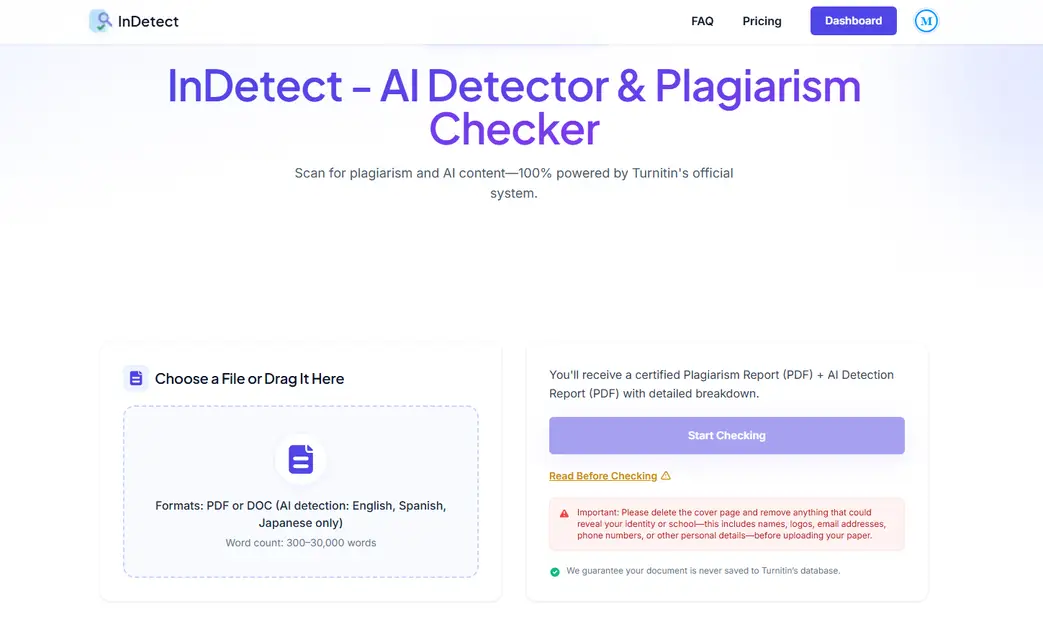
Upload your paper. PDF, DOCX, or TXT. Up to 20 MB. The text is extracted and hashed for duplicate detection.
Wait for routing. Your paper is queued for the next available instructor account. Median wait: 5 minutes. P95 wait: 30 minutes. We do not promise instant because the instructor accounts are shared resources.
Receive the report. The full Turnitin AI writing report, with per-paragraph breakdown and highlighted passages, delivered to your account dashboard. The report is also emailed to you as a PDF.
24-hour deletion. The paper and the report are scheduled for deletion from every system, including our own servers, within 24 hours. You can also hit "Delete now" to trigger immediate removal.
4.5 The Paid Plans
For students who need more than one check, or who are in a restricted region, the paid plans are priced at the real cost of the infrastructure plus a margin that keeps the free tier alive.
Plan | Price | Effective Per Check | Best For |
|---|---|---|---|
Single check | $9 | $9.00 | One paper, one deadline |
5-check bundle | $39 | $7.80 | A semester with two long papers |
10-check bundle | $69 | $6.90 | Graduate students with multiple chapters |
100-check bundle | $499 | $4.99 | Tutors, editors, ESL academies |
All paid plans include the same 24-hour deletion, the same instructor-account routing, the same real Turnitin report. There is no "premium" version of the report. You are not buying a better check. You are buying more of the same check.
The 100-check bundle is intentionally priced low per check because the abuse pattern we worry about is not bulk legitimate use. It is bulk illegitimate use, and legitimate bulk users (tutoring centers, academic editors) actually need consistent quality, which is exactly what the controls are designed to protect.
5. The Honest Decision Framework
You have read this far. The market is messy, the tools are inconsistent, the ToS is gray, and the only thing you actually want is to submit a paper without being wrongly accused. Here is the honest framework, no upsell.
5.1 Match the Tool to the Question
You want to know what your professor will actually see. Use a service that runs the real Turnitin engine. turnitindetect.app is the only one we know of that combines the real engine, the free tier, the strict controls, and the deletion guarantee. There are competitors. Most of them are simulators. The few real-engine competitors are more expensive or have weaker privacy controls. Choose deliberately, not by Google ranking.
You want a quick estimate of how "AI-flavored" your writing is, with zero upload risk. Use a local or open-source detector. GLTR (the Giant Language Model Test Room, from the University of Chicago) runs in your browser without uploading anything. It is rough, it is academic, and it is the only tool that never sees your paper. DetectGPT and Fast-DetectGPT, both open source, can be run on your own machine with a few hundred lines of Python. They are not as accurate as Turnitin. They are not pretending to be.
You want to protect your privacy absolutely. Do not upload your paper to any service that you have not personally audited. Write the paper in a text editor that does not sync to the cloud. Run a local detector. Submit through your university. The privacy cost of "free" is rarely worth the convenience.
5.2 The Ten-Point Pre-Flight Checklist
Before you submit any paper, anywhere, run this list. It takes fifteen minutes. It is the only checklist that will actually keep you out of trouble.
Read your school's AI policy. Find the syllabus language. Find the assignment prompt. If the policy is silent, email your professor and ask, in writing.
Preserve your version history. Google Docs and Word both keep it automatically. Export a PDF of the version history if you are paranoid.
Keep your outline and notes. Dated, ideally handwritten. They are evidence of process.
Save a tool-use log. Every time you used Grammarly, ChatGPT, QuillBot, or any other tool, write down what you used it for and when. One sentence per use is enough.
Disclose any AI use in your paper. A footnote, a methods section, a cover note. "Used ChatGPT to brainstorm counterarguments, then wrote the final version myself." This is not a confession. It is a citation.
Run your paper through a real Turnitin preview if you have access to one. turnitindetect.app offers this. A 35% preview score is a 35% real score. Plan around it.
Read your paper aloud. The single best detector is your own ear. If a sentence sounds like a press release, rewrite it. If a paragraph has no contractions, rewrite it. The patterns that flag AI are patterns you can hear.
Check your citations. AI tools hallucinate references. Every citation in your paper should resolve to a real source you actually read. If you cannot find the source, the AI made it up.
Check for the AI tells. Words like "underscores," "pivotal," "multifaceted," "in the realm of," "delve into," "navigating the landscape." They are not banned, but clusters of them are a flag. Rewrite the cluster.
Trust the process over the product. If you cannot explain how you wrote the paper, you are not ready to submit it. The detector is not the threat. The inability to defend your work is the threat.
5.3 The Deeper Fix
The honest answer to "where can I get a free Turnitin AI check" is not a URL. It is a set of habits. Build assignments that are AI-resistant by design: require sources only a real reader of the course would know, weigh process over product, run oral defenses on drafts, ask for in-class writing. These changes are coming to universities, slowly. They are not here yet. Until they arrive, you protect yourself with information, with documentation, and with the one tool that actually shows you the number that matters.
6. FAQ: Answers to Common "Free Turnitin AI Detection" Questions
Is Turnitin AI detection free for students?
No. Turnitin only sells its AI writing detector through institutional licenses. There is no student-facing free tier, no trial account, and no individual plan. Turnitin's help center states this explicitly. Any "free" Turnitin AI check you find online is a third-party service, and most do not run Turnitin's engine at all.
How can I check my Turnitin AI score for free?
The only way to see a genuine Turnitin AI report before submission is through a service that routes your paper through an instructor-level Turnitin account. turnitindetect.app offers one free check per eligible student — with country restrictions and anti-duplicate controls that keep the real-engine free tier sustainable. Free tools that run their own model (GPTZero, ZeroGPT, etc.) give you an estimate, not your actual Turnitin score.
Can students use Turnitin for free?
No. Turnitin is available only through universities that pay for an institutional license. Students cannot create a personal Turnitin account or upload papers for self-checking through the official platform. That is why the third-party market exists.
Do free AI detectors give the same score as Turnitin?
No. Free detectors train on different data, use different methods, and update on slower cycles than Turnitin's proprietary academic model. A low score on a free tool does not predict your score on Turnitin — only the engine your professor runs is a true measurement.
What is the most accurate free Turnitin AI detector?
Among free tools, GPTZero is the closest independent approximation to Turnitin because it is trained on academic text. But "closest" is still not the same: the report your professor sees comes from Turnitin's own model. If the score matters, use a service that runs the real engine.
7. Conclusion: There Is No Free Lunch, But There Is a Scarce Resource Worth Competing For
Three sentences to carry forward.
The phrase "free Turnitin AI detection" is a search-engine artifact, not a product. Turnitin has never sold one, and almost no service that ranks for that phrase actually runs Turnitin's engine. Most are simulators that give you a number that does not match the number your professor will see. Some are upsell funnels that harvest your paper on the way to a humanizer sale. A small number are gray-zone operators that run the real engine through instructor accounts, with all the legal and privacy risk that implies.
In that small number, turnitindetect.app is the only one we know of that runs the real engine, offers a genuine free tier, publishes its privacy and deletion terms, and enforces the anti-abuse controls necessary to keep the free tier alive. The country restrictions, the device fingerprinting, the document hashing, the 24-hour cooldowns — these are not obstacles. They are the cost of keeping a real-Turnitin free check available for the student who has one paper, one deadline, and no budget.
If you are eligible, claim your free check at turnitindetect.app. If you are not eligible, the paid plans start at $9 — cheap relative to the cost of a wrongly accused semester. If neither option is right for you, use the local tools, follow the ten-point checklist, and remember: no detector, free or paid, real or simulated, is a substitute for being able to explain how you wrote the work.
The arms race between AI generation and AI detection is not going to settle in your favor. The system will keep changing. The thresholds will keep shifting. The only durable protection is the boring one: write something you can defend, document how you wrote it, and know the rules before you break them.
Submit with your eyes open. Defend yourself with evidence. And do not let a search-result page, however confidently written, be the last word on a service that runs against the most consequential number in your academic life.
If this article changed how you think about the "free Turnitin AI detection" market, share it with one student who has a paper due this week. They will thank you before the deadline.