How to Reduce Turnitin Similarity Score (Legit Ways)

To lower your Turnitin similarity score, fix what's actually matching: put real quotations inside quotation marks with a citation, rewrite borrowed passages in your own words and still cite them, and delete the quotes you only added for padding. Synonym spinners don't work — Turnitin matches consecutive word strings, so swapped words over the same sentence skeleton still light up red. On our own test paper, those three moves took similarity from 50% down to 26%, with no paraphrasing tool involved.
A note on authorship. We're the team behind InDetect, a third-party pre-submission checker that runs papers through authorized instructor-level Turnitin accounts. We have a stake in you checking your work before you submit, so weigh that accordingly. The numbers here come from a real report on our own test paper, and the methods are the same ones writing centers teach.
Key Takeaways
Similarity isn't plagiarism — the report only shows matched word strings; you decide which matches are problems.
Three fixes cover almost everything: format your quotes, paraphrase for real (with citations), cut decorative references.
Synonym spinners fail because matching works on consecutive word strings — and spun text can make human writing look AI-generated.
Aim for your school's threshold (commonly 15–25% overall), not 0%. Over-reducing damages the paper.
Verify the fix with a real report from a no-repository service, so your draft never matches itself at submission.
1. First, Find Out What's Actually Matching
Before rewriting anything, triage the report. Every matched block tells you three things: where it matched (a website, a journal article, or another student's paper), how large that single source is, and whether the match sits inside your quotes or your reference list.
Different match types need different responses. A 4% match to a published article inside your lit review is usually a quoting problem. A 9% match to one source in your body paragraphs is a paraphrasing problem — or worse. Matches inside your bibliography are noise you can filter out.
Most reports let you exclude quotes, bibliographies, and small matches (often anything under 1% or a few words). Re-read the filtered number before you panic. Then look at the single-source column: instructors care far more about one 8% match than about ten 1% matches scattered across the paper.
Once you know what kind of match you're dealing with, pick the fix below.
2. Method 1: Quote It Properly
If a passage is worth keeping word-for-word, quote it. Short quotes go inside quotation marks, with author, year, and page, formatted in your required citation style.
Why this moves the number: most schools run Turnitin with the Quote Matcher enabled. Text inside proper quotation marks is recognized as a quotation and either excluded from the similarity total or separated into its own category. An unformatted "quote" — a copied sentence floating in your paragraph with no marks — looks exactly like copied-and-pasted text to the algorithm.
One rule of thumb: if you wouldn't say the sentence in your own voice, quote it. And don't stack quotes. A paragraph that's four quotations glued together tells your professor you never processed the material, similarity score aside.
3. Method 2: Paraphrase for Real
Real paraphrasing is not word substitution. It's reading a passage until you understand it, closing the source, writing the idea from memory, then reopening the source to check you didn't keep its structure — and citing it either way.
Here's the difference, using a sentence from our test paper:
Bad paraphrase (still matched): original "The study found a strong correlation between sleep duration and academic performance" rewritten as "The research discovered a strong link between how long students sleep and their academic results." Same skeleton, swapped synonyms. Turnitin still flags it.
Real paraphrase: "Students under six hours of sleep scored lower on exams, even once study hours were controlled for (Chen, 2024)." The sentence is rebuilt around your point, and the citation stays.
If you can't write the idea from memory, you don't understand it yet — which is also the point of the assignment.
4. Method 3: Cut the Decorative Citations
Some of your similarity comes from quotes you didn't need. Students drop a one-line quotation into every paragraph to look well-read or hit a citation count. Each one is matched text, and a pile of them inflates the score.
Replace decorative quotes with synthesis: one sentence that summarizes several sources and cites them together. "Multiple studies link short sleep to lower exam scores (Chen, 2024; Okafor, 2023; Reid, 2025)" does more analytical work than three glued quotations, and it matches far less text.
Keep the quotes that carry evidence — a definition, a claim you're arguing with, data phrased precisely. Cut the ones that only decorate.
5. Why Synonym Spinners Fail (and Make Things Worse)
Turnitin's similarity engine matches consecutive strings of words, not individual vocabulary items. A spinner swaps "significant" for "notable" but keeps your exact clause order, so the fingerprint survives. In our own test runs, spun paragraphs still came back matched.
There's a second problem. Spun text tends to flatten: uniform sentence lengths, odd word choices, no contractions. That statistical texture is exactly what AI writing detectors read. A spinner can lower your similarity score while pushing the same paper toward an AI flag. We've tested what the real engine catches across models in our Gemini, ChatGPT and Claude detection test, and the scoring mechanics are broken down in our guide to how Turnitin AI detection works.
Don't spin. Quote, paraphrase, cite.
6. How Low Should You Go?
There's no universal safe number, and anyone promising you one is selling something. Check your school's policy first. Many land around 15–25% overall, with single-source matches expected to be low, but individual departments set their own lines.
Don't chase 0%. An honest paper quotes sources, names shared technical terms, and uses the same standard phrasings as everyone else in the field. Those matches are legitimate. Our test paper ended at 26%, not 4% — and the remaining matches were properly quoted, cited material.
Over-reducing hurts you. Students who push toward zero delete necessary citations, mangle terminology, and hand in worse writing than they started with. Reduce until every remaining match is one you can defend, then stop.
7. Check Before You Submit — Without Feeding the Database
Don't guess whether your fixes worked. Run the revised draft through the real engine and compare the two reports.
The catch students worry about: will my paper show up in Turnitin if I check it first? It will — if the checker stores your draft in Turnitin's student paper repository. Then your real submission matches your own saved draft, sometimes at 100%, and you're accused of self-plagiarism. That's why the storage setting matters more than the price.
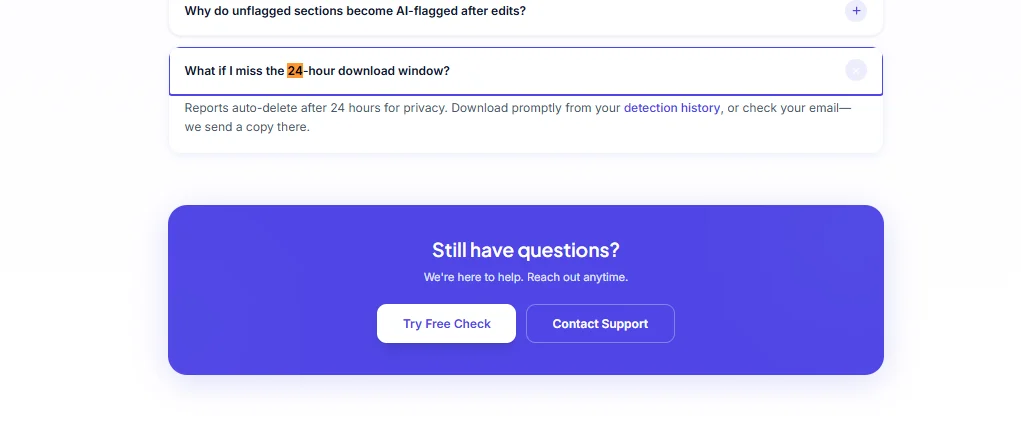
InDetect routes uploads through instructor accounts configured for zero repository storage, returns the full similarity + AI report in 5–30 minutes, and deletes the paper and report within 24 hours. Check the draft, fix it, check again — nothing from run one is sitting in a database waiting to match your final submission. We show the whole flow, screenshots included, in our full service review, and the pre-submission report itself is covered in our similarity check before submitting guide.
8. FAQ: Reducing Turnitin Similarity, Answered Honestly
How do I lower my Turnitin similarity score quickly and safely? Format every direct quote with quotation marks and a citation, re-paraphrase the matched passages from memory (still cited), and delete quotes you don't need. Those three moves took our test paper from 50% to 26%. Skip the spinners entirely.
Do paraphrasing tools actually reduce similarity? Not reliably. They swap words while keeping sentence structure, which is exactly what consecutive-string matching survives — and they can introduce flattened, AI-flavored writing in the process.
Why is my similarity still high after changing the words? Because changing words isn't changing structure. If the clause order and phrasing skeleton match the source, the block still matches. Rebuild the paragraph from memory, or quote it properly with marks and a citation.
Does a 20% similarity score mean plagiarism? No. Similarity is a match percentage, not a verdict. A 20% report made of properly quoted, cited material is fine at most schools; a 4% report containing one uncited copied paragraph isn't. Read what the matches actually are.
Will reducing similarity change my AI score? They're separate scores. Proper quoting and citing rarely move the AI number. Spinner-driven rewrites can push it the wrong way, because synonym-swapped text reads model-like.
9. Conclusion: Fix the Matches You Can't Defend
Open the report, triage the matches, quote, paraphrase, cut the padding — then verify with a real report instead of hoping. That's the entire method, and it's how our test paper went from 50% to 26% without a single spinner click.
New users in eligible countries get one free check; if you're revising more than once, Lite runs $9/month for 2 checks ($4.50 per paper), with the similarity and AI report both included every time.