How Does Turnitin AI Detection Actually Work?

Turnitin doesn't compute one "AI probability" for your whole paper. It breaks the text into segments, scores each sentence on how model-like its statistical patterns are — the kinds of signals Turnitin has publicly described using ideas like perplexity and burstiness — and the AI Writing percentage at the top of the report is the share of text flagged. Below roughly 20%, the official report shows an asterisk (*) instead of an exact number. Everything below follows Turnitin's own public documentation; the screenshots come from real reports on our test papers, not from anyone's submitted work.
A note on authorship. We write this from the other side of the report: InDetect is a third-party pre-submission checker that runs papers through authorized instructor-level Turnitin accounts. Seeing hundreds of real reports means we can describe the mechanics accurately — but we are not Turnitin, and we don't claim any knowledge of their internal model beyond what they publish.
Key Takeaways
Scoring happens at the sentence level; the headline percentage is just the flagged share of your text.
The detector reads statistical smoothness — predictable word choices and uniform rhythm — not whether your ideas "sound like AI."
Under about 20%, you see an asterisk instead of a number; a gray dash means the paper wasn't processed at all.
Turnitin itself calls the output a signal, not a verdict — and even good detectors misfire on human writing because of base rates.
The only way to see how your own sentences get flagged is to run the real engine before you submit.
1. The Short Version, If You Only Have 30 Seconds
Three sentences. Turnitin's AI writing detector analyzes your paper in segments, flagging each piece as likely AI-generated, likely human-written, or a mixture. The percentage at the top of the report is the proportion of analyzed text that got flagged. If that proportion falls below roughly 20%, Turnitin hides the exact number and shows an asterisk instead.
One more sentence, because it matters: Turnitin's own guidance describes the score as an indicator for instructors to investigate, not a finding of misconduct. A 30% report doesn't mean 30% of your work is fake. It means 30% of your sentences looked statistically smooth to a classifier.
2. Perplexity and Burstiness, Explained Without Math
Turnitin has publicly explained AI detection using two statistical ideas. You don't need the math, just the intuition.
Perplexity is, roughly, how surprising each next word is to a language model. Text that a model wrote tends to be made of the model's own most-likely word choices — smooth, predictable, low-perplexity. Humans wander: odd collocations, unexpected transitions, a weird adjective nobody would statistically reach for.
Burstiness is how much sentence length and structure vary. Humans write in bursts — a long winding clause, then three words. Then another long one. Models, left alone, settle into an even rhythm of medium-length sentences with the same openings.
Neither property is a law. Plenty of careful human writing is smooth and even — academic prose especially so. That's precisely why false positives exist, and why section 6 matters.
3. How Turnitin Scores Sentence by Sentence
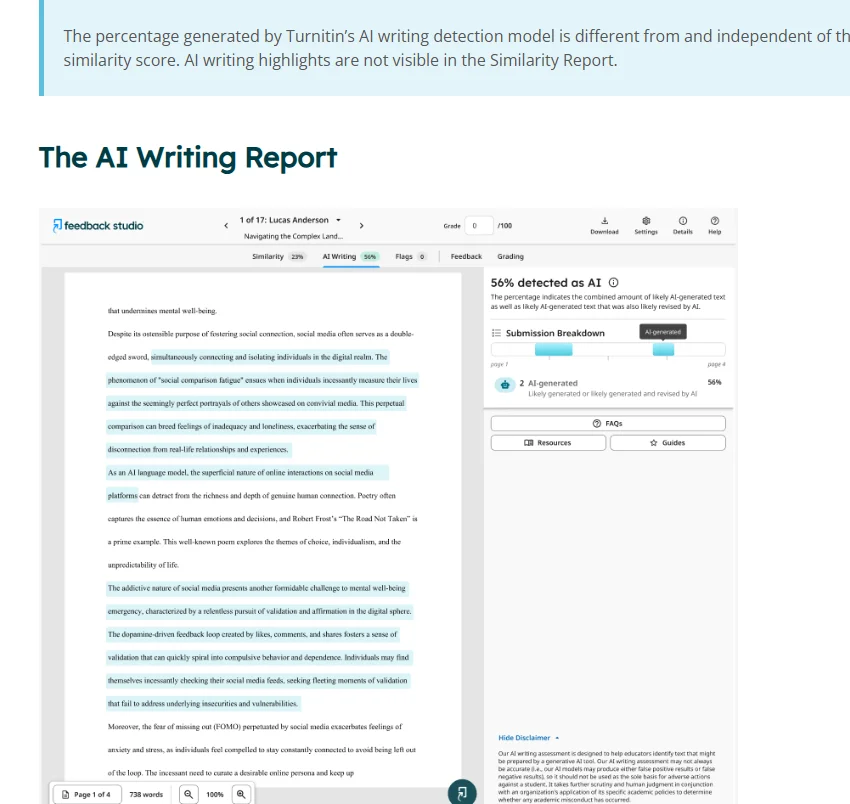
This is the part students most often misunderstand. The AI Writing report isn't a single verdict stamped on your document. Open one and you'll see the text highlighted in segments: passages marked as likely AI-generated, and passages marked as possibly mixed — part human, part machine. The colors in the document body correspond to what's in the score panel, exactly as Turnitin's official help documentation describes.
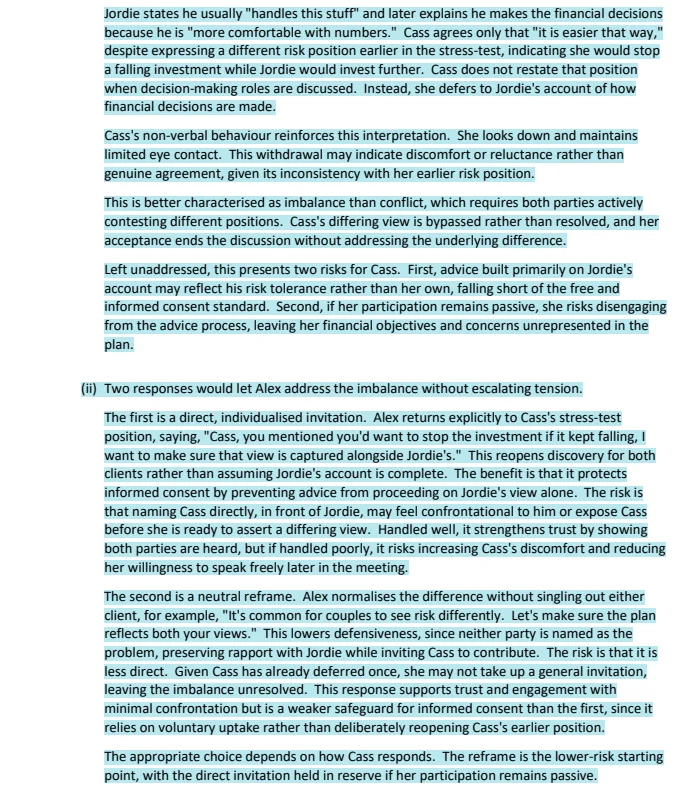
The top-line percentage is derived from those flagged segments: roughly, the share of analyzed sentences the classifier didn't consider fully human. That's why a paper you wrote entirely yourself can show a nonzero score — a few sentences that happened to read smooth get flagged, and the rest don't.
It's also why editing one paragraph can visibly move the number. The score is an aggregate of local decisions, not a property of your document as a whole.
4. Why You See * Instead of a Number
Three states appear in the AI Writing panel, and students mix them up constantly.
0% means the paper was analyzed and nothing was flagged. Clean, in the detector's narrow sense.
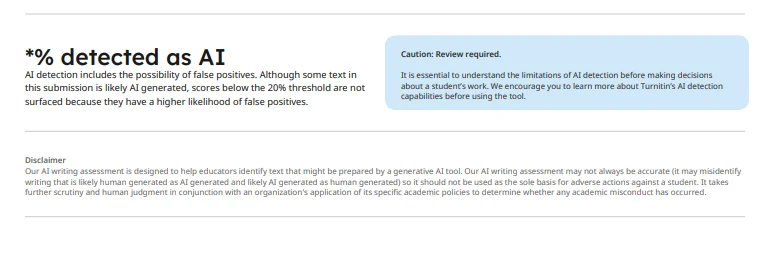
*% (an asterisk) means the paper was analyzed and the flagged share is nonzero but below the threshold — around 20% — where Turnitin considers the signal too unreliable to display as a precise number. It's not a hidden accusation; it's the company telling instructors "low enough that you shouldn't act on it." We cover the asterisk in detail in our explainer on what the asterisk score means.
A gray dash means the text wasn't processed at all — typically because it's too short or contains too little continuous prose for the detector to analyze. It is not a score of zero, and it is not an error on your part.
5. What Turnitin Does NOT Do
The rumors are worse than the reality. Worth stating plainly, based on what Turnitin has published:
It does not read file metadata — Word author fields, creation timestamps — to decide whether text is AI.
It does not detect whether your ideas were prompted. It analyzes word patterns, not thought origins.
It does not get a watermark signal from ChatGPT or any other model. Consumer chatbots don't embed a detectable tag, and Turnitin doesn't have a secret feed from OpenAI.
It does not run a single whole-document yes/no classifier. As above, the decisions are made per segment.
Turnitin's own wording for all of this is "signal, not verdict." The number starts a human's investigation. It doesn't end one.
6. The Base Rate Fallacy: Why Even a Good Detector Misfires
Here's the statistics lesson nobody teaches you before you get accused.
Suppose a detector wrongly flags 1 in 100 human-written papers. Sounds excellent. Now suppose 900 out of 1,000 submitted papers are genuinely human. That 1% error still flags 9 human papers. If only 100 papers are AI-written and the detector catches 80 of them, then 9 of the 89 flagged papers are innocent — about 1 in 10 flags is a false one.
The math isn't the detector's fault. Human writing is simply far more common than AI writing, so even a tiny error rate on the huge human population produces a meaningful number of false flags. That's the base rate fallacy, and it's why a flagged sentence is recoverable evidence, not proof.
If you're ever misflagged: your drafts, your version history, your outline, and your ability to walk a professor through how you wrote the paper are worth more than any score.
7. How to See the Same Scoring on Your Own Paper
You can't reason about your AI score in the abstract. You need to see which of your sentences get highlighted, before submission, in the real report your professor will see.
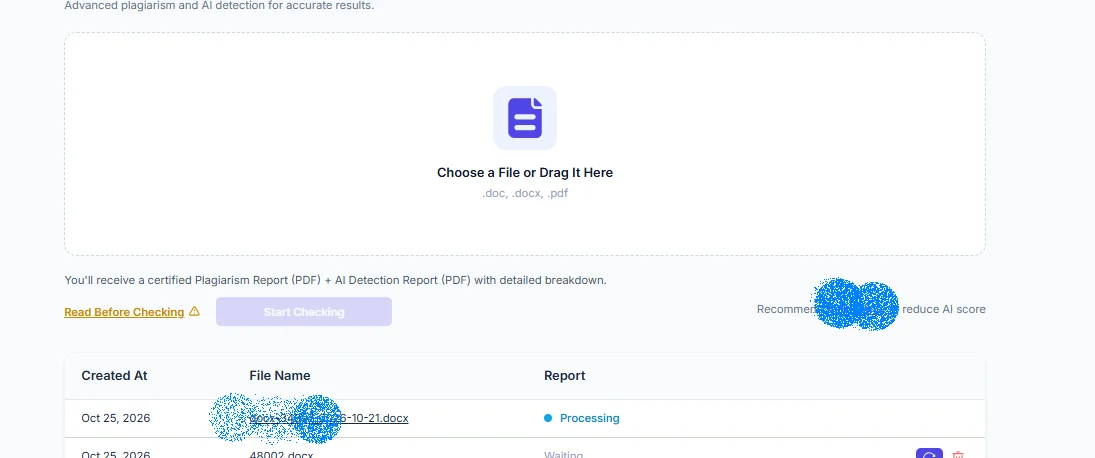
That's what InDetect does: your paper is routed through authorized instructor accounts configured for zero repository storage, the real Turnitin engine runs on it, and you get the full similarity + AI report in 5–30 minutes. The paper and report are deleted within 24 hours. We keep no database, so your preview can never match your submission. See the actual flow in our step-by-step service review, or compare it against other options in our guide to Turnitin checker tools. We've also run the engine against model-written text in our Gemini vs ChatGPT vs Claude detection test.
8. FAQ: How Turnitin AI Detection Works
Does Turnitin check the whole paper or sentence by sentence? It analyzes the text in segments and flags each one individually. The top-line AI Writing percentage is the flagged share of analyzed text, so the document-level number is an aggregate of sentence-level decisions.
What do the yellow and purple highlights in the AI report mean? They distinguish fully flagged passages (likely AI-generated) from partially flagged ones (possibly mixed human and AI text), per Turnitin's official report legend. The colors in the body correspond to the categories in the score panel.
Why does my Turnitin AI score show an asterisk instead of a number? Because the flagged share is below the threshold (around 20%) where Turnitin considers a precise number meaningful. An asterisk means a low, nonzero result — not a hidden penalty.
Can Turnitin be wrong about human-written text? Yes. Because human papers vastly outnumber AI papers, even a low false-positive rate produces a real number of wrongly flagged students. Turnitin itself frames the score as a signal for investigation, not a verdict.
Do formatting or grammar tools change the AI score? Formatting itself doesn't. Editing can — because the score comes from sentence-level statistical patterns, smoothing your prose with an aggressive rewriting tool can change which sentences get flagged.
9. Conclusion: It's a Sentence Classifier, Not a Mind Reader
Turnitin's AI detection scores segments, aggregates them into a percentage, hides the number below roughly 20%, and refuses to process text that's too short. It reads statistical texture, not intent, and even a well-built classifier misfires on human writing because of base rates.
If you want to know how your sentences will actually be flagged, run the real engine once before you submit. Eligible new users get one free check (availability depends on your country), or Lite at $9/month covers 2 checks ($4.50 per paper), report delivered in 5–30 minutes.