Turnitin AI Detection: What Every Student Should Know Before Submitting

You hit submit. You wait three hours. You get an email from your professor. The subject line says: "We need to talk about your paper."
Your stomach drops. You wrote that paper — late nights, three drafts, a stack of highlighters. You did not use ChatGPT. Maybe you used Grammarly. Maybe you checked a fact with Google. Maybe your roommate paraphrased a sentence for you. None of that feels like "AI writing," and yet a percentage on a screen says you might be a cheater.

This article is for you. Not to teach you how to trick a system. To explain, in plain language, what that percentage actually means, why it is far less reliable than your professor probably believes, and what you can do before and after a false flag.
The One Number You See Is Not the One That Matters
When Turnitin's AI writing detection runs on your paper, you typically see a single number: the percentage of text the model believes was generated by AI. Anything above 20% or 30% is usually treated as suspicious, depending on the instructor's policy.
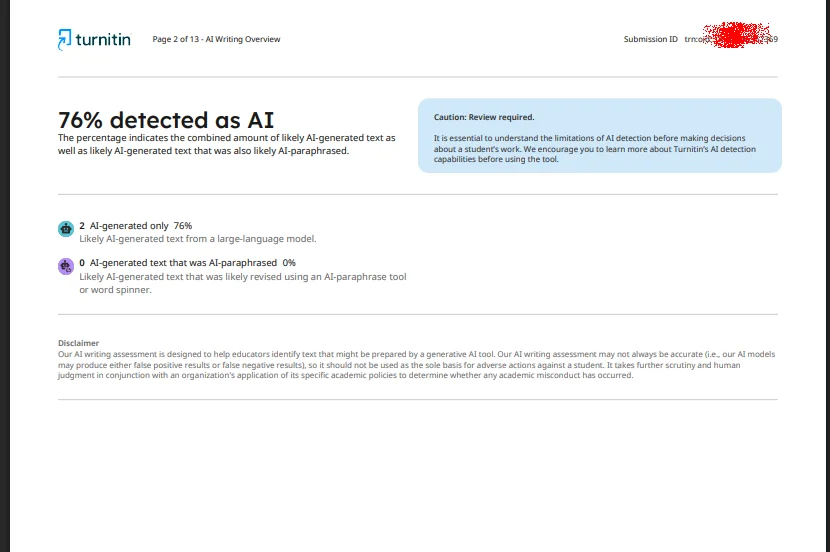
Here is the part almost nobody explains to students: that number comes from a classifier, and classifiers make two kinds of mistakes.
False positive: a human-written paper is flagged as AI.
False negative: an AI-written paper is flagged as human.
Turnitin advertises an overall accuracy above 98% on its detection model. That figure is technically true, and practically misleading, for a reason that has nothing to do with cheating and everything to do with math.
Imagine a university where only 1 in 100 students actually uses AI to write a paper. If a detector has even a 1% false-positive rate — meaning 1 in 100 honest students gets flagged — then for every true cheat it catches, it punishes one innocent student. The detector can be 99% "accurate" and still be wrong half the time about the specific person sitting in front of you.
This is called the base rate fallacy, and it is the single most important concept to understand about AI detection. The rarer the actual cheating, the more "accurate" detectors must be to avoid destroying innocent students' grades. Most published accuracy numbers do not account for this.
What Is Turnitin Actually Measuring?
Turnitin's AI detection is not reading your paper and judging your intent. It is computing statistical features of your text. Three of these features drive most of its decisions.
Perplexity
Perplexity measures how "surprising" each word is, given the words that came before it. A text that always picks the most predictable next word has low perplexity. AI models, especially in their default settings, tend to write in low-perplexity text. So do:
Students writing about a topic they do not fully understand.
Non-native English speakers using formal vocabulary.
Anyone using a grammar checker that suggests "better" word choices.
People writing under time pressure, who stick to safe, simple phrasing.
Burstiness
Burstiness is the variation in sentence length and complexity across a passage. Human writing naturally spikes — one short punchy sentence, then a long winding one. AI writing tends to be more uniform. But human writing under stress, academic writing following a template, and many editing processes also flatten burstiness.
Token Distribution
The detector looks at which words appear, how often, and in what patterns. AI text has a recognizable "fingerprint" of word choice. So does academic prose in general, so does any writing that has been through multiple rounds of grammar correction.
Here is the crucial point that your professor may not have been told: these three measurements do not detect "AI writing." They detect "text that statistically resembles the average output of a large language model." Those are not the same thing. The first is an accusation. The second is a probability.
Who Gets Falsely Flagged?
The students who get hurt by false positives are not random. They fall into recognizable groups.
Non-native English speakers. If you learned academic English from textbooks rather than conversation, your writing is naturally closer to the "average" formal text that detectors were trained on. Studies have repeatedly found that ESL students receive higher AI scores than native speakers writing the same content.
Students with formal writing styles. If you were taught to write in the five-paragraph essay style, you have been trained to produce exactly the kind of uniform, well-structured prose that detectors flag. You are being penalized for following instructions.
Anxious over-editors. The student who rewrites every sentence five times, who uses Grammarly Premium, who asks a friend to "just make this sound better" — that student is the most likely to trip the detector. The editing process is flattening the very human quirks the system is looking for.
Students with neurodivergent writing patterns. ADHD, autism spectrum, and other cognitive profiles often produce distinctive sentence rhythms. These can be exactly the "human" markers detectors want, or they can be flagged as too erratic. There is no consistent safe pattern.
Anyone using legitimate AI assistance. Used ChatGPT to outline your argument? Asked it to summarize a source? Had it check your grammar paragraph by paragraph? Depending on how you used it, your final draft may register anywhere from 5% to 95% AI. The detector cannot tell the difference between "AI wrote this" and "AI helped with this."
The Black Box Problem
Turnitin has never published a full description of its training data, its false positive rate on independent samples, or its confusion matrix. Independent researchers, including a team at Stanford, have tested the system and found meaningful variation in how it scores identical content depending on formatting, document version, and presentation.
This matters because your professor is making a decision about you based on a number generated by a system that:
Has not been independently audited at scale.
Does not explain why a particular sentence was flagged.
Cannot be appealed to on the basis of "show me the rule it broke."
If you are flagged, you are asked to defend yourself against an accuser who will not say what it saw, only that it is "very confident."
Where to Check Your Paper Before Submission
Here is the uncomfortable part. Turnitin's official platform does not let you, the student, see your AI detection report. Your instructor controls whether the report is generated, when it is generated, and whether you are shown the result. In many courses, you submit a paper, the AI score is computed, and you never get to look at it until after a grade has already been entered.
This puts students in a strange position. You cannot see the report, but you are responsible for it.
The only way to check your own AI score before submitting to your professor is to use a third-party service that runs the same Turnitin engine from an instructor-level account. The leading option is InDetect at turnitindetect.app.
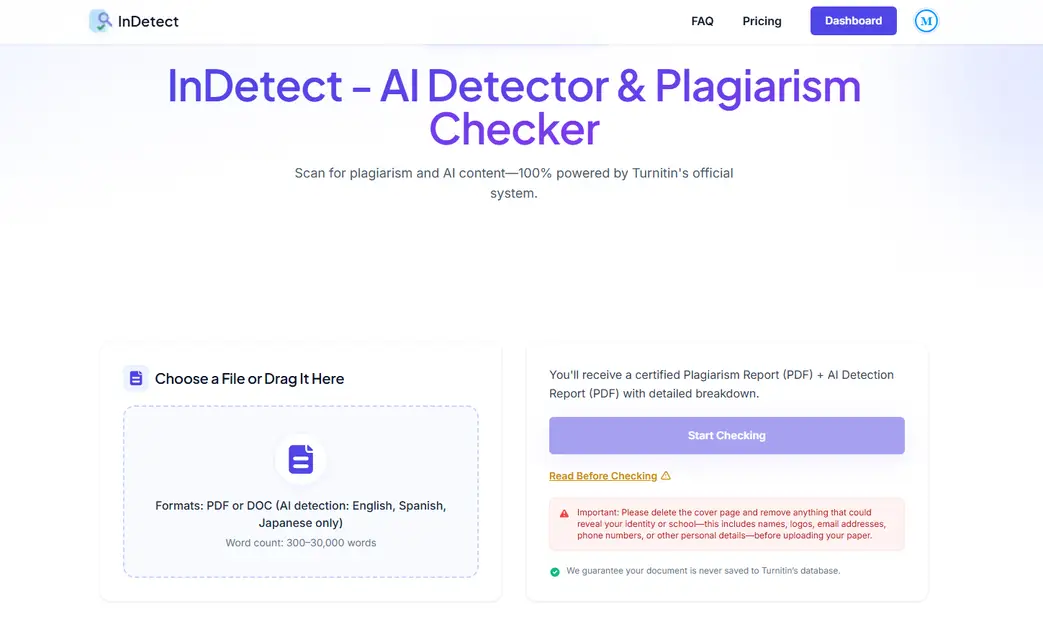
InDetect works with a network of authorized instructor accounts to generate the same similarity and AI reports your university uses. You upload your paper, you get the report within 5 to 30 minutes, and — critically — your document is never added to Turnitin's student paper repository. A 24-hour deletion policy means your paper is removed from every system, including InDetect's own servers, within a day.
The practical workflow is simple. A few days before your deadline, upload your draft to InDetect. Look at the AI percentage. If it is high, you know which paragraphs are triggering the detector, and you can rewrite them in your own voice before your professor ever sees the paper. You are not trying to cheat a system. You are trying to see the same report your professor will see, so you can fix problems before they become accusations.
New users get one free check. If you want to test multiple drafts across a semester, the paid plans are priced for students.
Other third-party options exist with different trade-offs in speed, price, and reliability. Whichever service you use, the principle is the same: do not submit a paper to your university without first knowing what an AI detector thinks of it. You cannot defend yourself against a number you have never seen.
What To Do If You Are Already Flagged
If you have already received a notification that your paper was flagged for AI content, take these steps in order.
Do not confess to anything you did not do. A flagged paper is not proof. It is a probability estimate from a statistical model. Many honest students have been flagged, and many have successfully appealed.
Request the full report. Ask your professor, in writing, for the complete Turnitin AI report including the highlighted passages and the per-paragraph breakdown. Some institutions will provide this on request. If they refuse, note the refusal in writing. It is relevant to any future appeal.
Document your writing process. This is the single most important step, and the one students skip. If you have any of the following, gather them now:
Google Docs or Word version history showing drafts over multiple days.
Outline notes, even handwritten, dated before you started writing.
Reading lists or sources you consulted.
Email or chat conversations with classmates about the topic.
Any rough drafts, even partial ones.
A written timeline of when you worked on the paper.
Request an in-person conversation. A flagged paper should not be resolved over email. Ask to meet with your professor, bring your documentation, and explain how you actually wrote the paper. Most professors are reasonable people who have heard the same vague accusation many times. A calm, evidence-backed conversation is your strongest tool.
Know your institution's appeals process. Every accredited university has a formal grade appeal process. If your professor refuses to reconsider, escalate. Bring the same documentation. Reference the base rate fallacy, the false positive rate, and the fact that you are being asked to disprove a negative produced by an unaudited system.
Consider involving the dean of students or student ombudsman. These offices exist for exactly this kind of dispute. They are not just for academic misconduct hearings. They can mediate before the situation escalates.
A Note on Actually Using AI
This article is not a tutorial on hiding AI use. The honest truth is that the rules around AI in academic work are still being written, and the worst thing you can do is pretend they do not exist.
If your syllabus says no AI, do not use AI. If your syllabus says AI is allowed for specific tasks, use it only for those tasks. If your syllabus is silent, ask your professor directly, in writing, what is permitted.
The students who get in trouble are rarely the ones who used AI carefully within stated rules. They are the ones who either broke clear rules or used AI as a substitute for their own thinking and then could not explain their own paper when asked.
If you do use AI as part of your process — for outlining, for grammar checking, for summarizing sources — keep a record. A simple note in your draft: "Used ChatGPT to brainstorm counterarguments, then wrote final version in my own words." A dated log of what you used and why. This is not just defensive documentation. It is good academic practice in 2026.
The Bigger Picture
The uncomfortable reality is that AI detection, as a technology, is in a losing arms race. Every month, language models get better at producing human-like text. Every month, the gap between "average human writing" and "average AI writing" narrows. The detection systems are not improving at the same pace.
What this means in practice: a system that catches 98% of cheating today may catch 70% in two years, while the false positive rate stays the same or worsens. The students who suffer are not the cheats, who adapt quickly. The students who suffer are the honest ones whose writing happens to match the detector's idea of "suspicious."
The longer institutions rely on Turnitin's AI score as a primary judgment tool, the more they will punish innocent students. The alternative is harder work: redesigning assignments to be AI-resistant by design, weighing process over product, using oral defenses, requiring sources and documentation that AI cannot fabricate.
These changes are coming. Slowly. Not fast enough.
Until they arrive, your best protection is information. Know what the number means. Know who gets falsely flagged. See your own report before your professor does. Document your process. And remember: a percentage on a screen is not the same thing as truth.
Summary
The AI percentage Turnitin shows is a probability estimate, not proof.
A 98% accurate detector can still wrongly flag half the students in a low-cheating environment.
Non-native speakers, formal writers, and over-editors are most at risk of false positives.
Students cannot see their official AI report before submission.
InDetect (turnitindetect.app) lets students preview the same report their professor will see, with full privacy protection.
If you are flagged, gather your writing history and request a face-to-face conversation before confessing or accepting the accusation.
Document any AI assistance you use, even if it is just grammar checking.
Submit with your eyes open. Defend yourself with evidence. And do not let a number on a screen be the last word on what you are capable of writing.